Category: Bible and Life

Pearl of Great Price

68dd1e8f51bcd1232187e4d717d3113b

“The kingdom of heaven is like treasure hidden in a field, which a man found and covered up. Then in his joy he goes and sells all that he has and buys that field.”

“Again, the kingdom of heaven is like a merchant in search of fine pearls, who, on finding one pearl of great value, went and sold all that he had and bought it.”

-Jesus

Talk about sold out.

These short parables about the kingdom of heaven have one purpose: to teach just how priceless the Kingdom really is.

Jesus taught that this Kingdom is so valuable it’s worth selling everything for. Uprooting your life. Liquidating your possessions. Selling out. Being a part of Kingdom work is worth more than you can ever earn in your life. In fact, it’s worth your very life itself.

Do you value the Kingdom of heaven like that?

And what even is the Kingdom of heaven? Hold that thought and I’ll circle back around to it.

I’m moving to Uganda soon. I’m packing up just about everything I own worth taking, hopping on a plane, and starting a new life in an African country I’ve only set foot in recently, for less than two weeks. Sounds kind of crazy. I never count myself as an authority on what’s crazy and what’s not anymore, but I’ve heard many of you say that… “Is it safe?” “How can you live like that?” “You’re my hero!” “I couldn’t do what you do.” And the list goes on.

And I’ll admit, yes, there are some moments when I question my sanity. They come when I’m making packing lists or sitting on a plane by myself. But then I remember that there is nothing I love more than looking into a pair of eager eyes while doing the hard work of discipleship. Never do I feel more fulfilled than when I pace a dirt floor and tell a Bible story. Squatting by a fire, drinking tea together, struggling against a foreign language to communicate truth. Those are the things light a fire in my heart.

That, my friends, is the Kingdom of heaven. Being in the presence of our Lord, going about his work, and pleasing him with our offerings of faith and sacrificial work—those are worth every minute of your life you can give. Loving our Lord and sharing his task of discipling the whole world to bring them to the feet of our Father is not so crazy after all. It’s a pearl of great price, a hidden treasure of great value, something you would happily be sold out to pursue.

So, going to Uganda isn’t so crazy after all. And I’m not a super Christian. I’m not any more faithful or any more committed or sacrificial than the rest of you.

I love speaking at churches. I love sharing my heart for the Lord and his work overseas. I really do. But I always cringe at those comments above that mark me as special. The ones that put me in a different category, border on reverence, and are a little too heavy with well-meaning but ignorant adoration. I’m not a supermissionary. I’m not even an overly mature Christian. Just because searching for my ‘treasure hidden in the field’ takes me overseas, that doesn’t mean that I follow the Lord any more closely than those of you who search for your ‘pearl of great value’ here in the States.

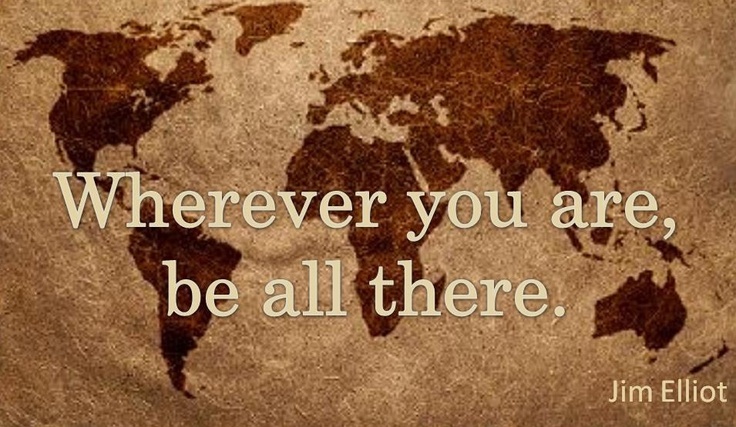
Jim Elliot was a missionary who was certainly sold out when it came to offering all he had in service of his Lord and the Good News about Him. This is one of his quotes you might have heard before:

“Wherever you are, be all there! Live to the hilt every situation you believe to be the will of God.”

The kingdom of heaven is worth seeking out wherever we find ourselves and in whatever phase of life. Live to the hilt. Be all buried in the opportunities you have to mentor or disciple, to make a difference in the lives around you for the sake of the kingdom and its King.

I recently visited a string of friends and was struck by how faithful they were in their various lives. I didn’t feel at all superior to the friends who are redeeming the time by fostering a child whose life they may eternally impact. I am no more holy than the friend working toward a job to advocate for immigrants and to faithfully live out Christlike character in her corner of the world. I am certainly no more sanctified than the friend who has just begun the years-long work of raising a family to follow after Jesus. I am not seeking out the kingdom of heaven any harder than the friends who are in school to better train for a lifetime of service that will point huge networks of people to the feet of our Heavenly Father, one interaction at a time. Those friends are my heroes, and I certainly could not live their lives or do what they do.

But that’s the way of the kingdom of heaven. Some of us work the ground to find it. Some of us sell what we have to find it. Some of us buy fields. Some of us are merchants. Some of us move overseas. Some of us make disciples in the same town we grew up in. It takes all of us to make disciples to the ends of the earth. It takes all of us being sold out.

What are some ways you can daily build your life to reflect the priceless treasure you have in your Lord Jesus, and what are some actions you can take to be about kingdom work?


Faith Without Works is Like a Song You Can’t Sing

screen-door-on-a-submarine

James was written in the Hebrew tradition of mashal, or wisdom literature. Mashal is a word for a parable, but it can mean much more than that: a proverb, ethical wisdom, a story that teaches wisdom, or poetry that works as a memory aid for bits of wisdom. You can read a mashal anywhere in Proverbs, Ecclesiastes, or in lots of Jesus’ preaching and teaching.

Because Jesus taught with these ‘wisdom stories,’ they would have been a familiar teaching technique to his brother, James. James uses this teaching style in his short letter so well that many people who read it are reminded of one of Jesus’ most famous teachings—the Sermon on the Mount from Matthew 5-7.

The wisdom that James taught with the mashal in his letter was the practical and applied nature of our faith. I’ve been taught in the past that the letter deals with faith and works, answering questions about how true faith correlates to obedience in our daily lives. These works don’t save us, I’ve been taught, but they’re more of an ‘indicator light’ like you’d find on your car dashboard; if you have a good, solid faith, your works light up alongside it to mark it. Whatever the ‘works’ were was left as some fuzzy category of vague obedience, in my mind.

But James is anything but fuzzy. He tells us we can’t just listen to the Word, or Scripture, but that we have to obey it too, and that if we don’t we’re unwise and foolish. He caps off chapter 1 by saying that real faith produces works. The two don’t just accompany other, but grow from each other. His final words on that topic are familiar: “Religion that God our Father accepts as pure and faultless is this: to look after orphans and widows in their distress and to keep oneself from being polluted by the world.” Real faith, or religion, IS works, and most specifically it’s the work of caring for people who need it most. James tells us our faith is caring for the marginalized, the oppressed, the poor, and the lonely, and doing so with a holy heart not swayed by the things of this world that would distract us.

What are those things that distract us from the poor and distressed? What keeps us from them? In my personal experience, it is pride, power, position, wealth, and privilege. When I love these things too much to look a beggar in the eyes or offer him some food, James says my religion is worthless. When I listen politely and nod along as someone grieves and laments, my religion is worthless. When I have the opportunity to listen to the voice of someone different than me, someone often neglected and unheard just like James’ widows and orphans, and I dismiss that opportunity, my religion is useless. It is dead, and deceptive.

That may seem harsh to us, or maybe overstated, but you don’t have to take my word for it.

James goes on in chapter 2 to say the very same thing. He tells the story of a rich man who comes to a gathering of believers and is treated with honor, while the poor man is welcomed to sit on the floor, or not even offered a seat. James warns us against favoritism towards those with privilege, power, or wealth. Partiality is a sin. It’s a work that shows our faith is not mature. It’s easy to hear Jesus’ words echoed here, from the end of Matthew 5, “If you love those who love you, what reward will you get? Are not even the tax collectors doing that? And if you greet only your own people, what are you doing more than others? Do not even pagans do that?”

James goes on to remind us that God has chosen the poor to inherit the kingdom (which should remind us again of Jesus’ “blessed are the poor in spirit…” beatitudes), and he tells us that breaking the law about loving your neighbor as yourself is a sin just the same as adultery or murder.

Soak that in for a second. James compares favoritism with adultery and murder. This is serious.

What good is our faith if it has not action to go with it, James asks us in 2:14? Is it even real faith? Can it save? If one of our brothers and sisters has no clothes or food and we tell them, “I hope things get better,” or “my thoughts and prayers are with you,” or “Go in peace, I hope you’re warm and full,” our faith is dead. James points out here what is called a sin of omission. It’s a sin that you commit by not doing something you’re supposed to do. For example, Moses taught us to honor our mother and father. When we don’t do that, we sin. It’s the same here. When we don’t value our brothers and sisters equally in Christ, we sin. We sin just as deeply as if we’d murdered.

That is massive. If our churches don’t listen to the voice of the poor man, the one with shabby clothes, the one we tell to stand in the corner, the old, the young, the foreign, the minority, the women, the ethnically different, James says we sin and our faith is dead without these deeds. When I don’t actively show my brother or sister with a different skin tone or eye shape that I value them, maybe I have functionally murdered them by taking away their voice and their seat in the room with me. In James 2:17-19 he compares such inaction to the ‘faith’ of the demons, who also believe in God but refuse to follow him in obedience.

James rounds off chapter 2 by explaining that true faith isn’t just correlated with works, but that it compels us irresistibly toward works. Our faith should lead to radical sacrifice of what is dear to us, like Abraham giving up his only son Isaac. Is our comfort zone so dear to us that we can’t give it up to have awkward conversations with people who feel excluded or voiceless in our churches? James also says that that kind of Abrahamic faith-to-works should cut across stereotypes like the faith the prostitute Rahab showed through caring for people who had no claim on her. If you read James and don’t want to be like Rahab, you’re doing it wrong.

James preaches what many today would call a social gospel. And many who would call it that shudder and squirm. Faith is about saving our souls, they say. Faith is about redeeming our minds and our wills. Faith is about heaven and eternal salvation.

But James won’t accept that answer, at least not as a whole answer. Faith is about action, in our real world, to care for real people, who may not deserve our attention, but whom God declared deserve grace under the new covenant just as much as we do. Perhaps they deserve it even more, given God’s repeated emphasis on the poor in spirit and broken-hearted. James closes chapter 2 by saying our faith must be accompanied by social action or we aren’t really talking about real faith or the whole gospel. “As the body without the spirit is dead,” he says, “so faith without deeds is dead.” Just like you can’t have a body or soul without the other, our faith is dead if it’s just about our soul. It must care for the body too.

One of my favorite childhood songs was by Rich Mullins. It has the line, “faith without works is like a song you can’t sing—it’s about as useless as a screen door on a submarine.” This message from James is rough. It’s convicting. And it makes me consider many different aspects of my interactions and care for people. But it has beauty too. A song you can’t sing is depressing, a hollow promise. But when we get this right and evaluate and make changes to listen and include better, our faith can sing. It can be welcoming and warm, truly showing love to everyone. Is your faith the kind that falls silent in the throat, or is it the kind that sings?

Summer Symphony

Free Matinee tickets

We listen from black vinyl bucket seats

Atop a puttering tractor.


Standing hay sighs slowly in the breeze.

Grasshoppers flick in the dry stems.


Hidden crickets raise an alarm

And grind into a higher gear

To match the tractor’s engine.


Cicadas in their perches

Count the rising temperature

With anxious screeches.


Gravel groans beneath hooves, tires, feet

And the cow’s tail swipes and slaps at gnats.


Oaks creak and stretch in the wind,

Their scorched leaves lazily clap.

Mind the Gap

How long ago was it that you last read a book written by a woman? How about one written by someone with a different skin tone than you? What about one written by someone whose native language is different from yours?

As widely-read as you may be, natural biases and supply and demand often combine to make your reading list an echo chamber—you only hear variations on your own voice. My seminary booklist for the semester of my writing is quite extensive, but every one of my books is written by a white man. I found two authors whose native languages differ from my own, but they were still educated under the same systems in the States.

Do we not miss a richness when we choose to learn only from those within our own culture, who already share our ideas?

I sometimes feel starved for the perspective of a female professor, or the lively teaching style of an African American brother. I can’t help but wonder if I would understand a Bible story better if it were taught by a Middle-Easterner, or if my concept of Christian suffering would have more staying power if it were informed by refugee.

Theology in particular is one discipline which suffers much at the hands of this diversity drought. Seven or eight years ago I sat in a college classroom learning about theology from a professor I still respect very much. He taught us about systematic theology—the study of all Christian doctrines and beliefs and how they harmonize into one unified, biblical system. For all his strengths, my professor did not teach me that culture and society radically shape each individual’s theology. He taught me that the theology I was learning was all there was—the creeds, the councils, the theologians like Augustine and Aquinas, all of them fed into one stream I shared, sitting in that college classroom with squeaky desks. And I did share in that stream, that culture of resources and thinking, but little did I know the other streams I could access.

My understanding of the uniformity of theology began to crack a little when I lived in Bulgaria and worked with the Roma people. All of the sudden, the Five Points of Calvinism were far less important than what the ‘baptism of the Spirit’ meant, and whether or not it was biblical. My friends were outside of the traditions of Western Christianity, and their spiritual landscape was vastly different than my own and the teaching I had encountered. They had questions I couldn’t even begin to answer. My white theology wasn’t good enough. And I slowly began to realize that what I had been taught was systematic theology was really just my white Christian heritage. There was nothing wrong with it as an individual perspective, but it certainly wasn’t the only perspective to be had.

Since that time, I have sought out teaching on cultural theology. All of us Christians come to the Word of God from a starting point. Whether we come as women or men, poor or rich, single or married, or whatever our color, we bring ourselves to the table just as we are. We can’t help but see the world of the Bible through our own eyes, because what other eyes do we have? If we’re wealthy and well-situated we identify with Abraham, Nicodemus, or Paul. Women are drawn to the stories of the Woman at the Well, Esther, and Ruth. Minorities see how God cares for the oppressed and demands social justice. And slowly but surely, the stories we are drawn to shape our understanding of who God is and how he interacts with us. Little nuances in culture, character, and past shape how we understand God.

Now, notice that I didn’t say my culture shapes who God is. Our differences do not give us license to fashion a God suitable for us, because God is exactly who the Bible says he is. Period. But our differences do explain how a black brother or sister might understand God’s zeal for freedom better, how a woman could understand God’s care for the voiceless better, or how a persecuted brother or sister may better understand what Jesus meant when said to count the cost. Our experiences mean that certain stories are more precious to us as individuals or because of our cultural identities. Certain Scriptures resonate with our emotions because our experiences help us see ourselves in stories someone else might struggle to identify with.

These cultural differences lead to differences in belief and practice that emphasize certain traits of God over others. These theologies even have labels, but they’re whispered in the corners or condemned from behind a lectern as ‘different’ or ‘distortions.’ Liberation theology. Black theology. And the F-word of good, Southern Baptists: feminist theology. All of these variations and more have some redeeming and praiseworthy qualities. They have valid perspectives on real biblical content. But any of these theologies alone, even white orthodox theology, can spin into disproportion when taken without balance from other cultural views. We need our brothers and sisters who are different than us to help us balance what we understand about God from the Scritpures.

We must dialogue between our theological perspectives. When we pad our rooms and our discussions with people like us, we miss the gift of diverse cultural perspectives God gives us. If our divisions of culture and sex are reflections the image of God, we each form an integral part of His Body here in the Church.

I asked before if we missed richness by cloistering together in like groups. I believe it’s more than that. We miss wholeness. When God created male and female, he created them both in his image, both as a unique representation of his qualities and character. When redeemed, our cultural differences are like that too. Our cultures and their resulting theologies uniquely reflect aspects of God’s character, and when we cut ourselves off from ideas outside the ‘mainstream’ we consign ourselves to a small corner of a masterpiece, never to see the whole painting by the Master.

So what do we do, brothers and sisters?

We have to mind the gap. Intentionally seek what you’re missing out on. Read a book by someone whose name you can’t pronounce. Listen to sermons, podcasts, or blogs from someone with a different skin tone or eye shape than yours. Learn from voices with richer and more colorful tones than your own. Make the most of opportunities to widen perspectives and voice the unsaid.

Try this sermon for starters, dear brothers and sisters. Don’t be defensive, but listen. Really listen. And try to put yourselves in the shoes of someone who has had to walk twice as far as you to be heard.

Charlie Dates: Overcoming Divisions

Mind the gap.

Ezekiel: Scandalous Shame or Answering Hope?

Ezekiel is no joke. It can be a difficult book to read and certainly is difficult to understand. It often gets skipped over in Bible studies and sermons, and there are quite a few reasons for that. The book is arguably the most graphic in the Bible in terms of sexual and violent content. As literature in the apocalyptic genre, it measures high on the bizarre-o-meter with symbols, prophecy, and motifs that have no tether in our modern experience.

I always forget how graphic the book is. I don’t know Hebrew, but I get the feeling our translations of “member” for penis and “issue” for semen and “bosom” for nipples and “whoring” for sex are sanitized—words the prophet meant to be raw and irritating to us we gloss over with a euphemism. So why did he use them? What was the point? Certainly sexuality has a good and holy place in the lives of believers, but if that was Ezekiel’s point we’d have another Song of Songs instead of the graphic descriptions of lust, an affair, and acts of prostitution that Ezekiel writes.

To say nothing of the graphic depictions of violence including evisceration, rape, and rivers of blood, the sexuality in Ezekiel chapters 16 and 23 goes far beyond acceptable dinner conversation. But the prophet might not have known much about table manners. He was the one, after all, who ate food cooked over a poop fire for more than a year. I find it most likely Ezekiel is avoided in polite church conversation for this reason—he spoke about and did shameful things that make our skin crawl, make us want to take a bath. The shock of his writings often provokes physical responses like sweating, blushing, racing heart, tears, or shaking. We avoid the book because it’s uncomfortable. It makes us cringe.

But that’s the point of the book. One of its themes is shame, and not just any shame, the particular shame we feel when exposed at our dirtiest, most disgusting moments of sin. It’s the quality of shame we would feel if our deepest and darkest sins were found out. Ezekiel wrote and acted with shock to wake God’s people up to their sin, to convict them, and to call them out of it.

Have you ever asked yourself why the Old Testament so often uses sex and adultery as a picture for sin and falling away from God? Why that metaphor, and why so often? What does it have to teach us? Maybe we should ask why we don’t describe our sin that way today. Why is it more common to hear “food, work, busyness, etc. is becoming an idol in my life” than “I’m cheating on God with my binge eating” or ‘I’m having an affair with my schedule”? Granted, those don’t roll off the tongue as well, but why do we describe our sin differently than God does?

We often describe things as idols in our lives without any real reference to what idolatry meant to the Israelite people, or to real idol worship today. We misinterpret and overuse the idea of idolatry, which was exchanging God for another and totally betraying him. To the Israelites, idolatry was leaving one covenant and seeking another, totally depending on another god to provide for needs God had already promised to provide. We sanitize that word, idolatry, make it metaphorical, and use it to refer to the way we let the score of the sports game control our emotions, or our overeating, or the fact that we find too much security in our bank account. We call it idolatry because we don’t have firsthand experience with idols. We don’t connect our cutesy, pre-packaged words for sin with slaughtering our children in total devotion to idols like Ezekiel talks about.

Through the Lord’s inspiration, Ezekiel knew that perverted sexual appetite was a much better analogy for our sin habits we won’t kick. I believe we leave out the topic of sex from or conversations far too much anyway, but I also think Ezekiel’s graphic depiction of nymphomania and lust-crazed infidelity is actually a better picture of what we so quaintly call idolatry. Do you worship that football game you watch on Sundays? Or would it be more accurate to say you lust over it, fantasize about it, spend all your spare moments imagining how it might play out? Do you sacrifice your children for your gluttony, or do you fantasize about that meal or dessert you want to eat, count the time until you can consume it, imagine what it will taste like, dwell on it? Is your bank account an idol, or is it the secretive little thought that comes to you in spare moments to soothe you or make you discontented? Is idol worship more your pace of sin habits, or is it lust—wild-eyed, insatiable, ever-present sinfulness, an appetite that consumes and controls you at the expense of whatever else deserves your attention more?

We all know what lust feels like, a burning thought or desire you can’t quite put away, that leaves you feeling dirty but aroused, alive. With lust, we mentally throw caution to the wind because it’s hidden, and no amount of conversation or probing lets it out unless we allow it. Are your sin habits more like that? I know mine are. So pick your poison. Idolatry, or lust? Idolatry replaces God in an act of finality and betrayal. An idolater has at least made up his mind. Someone consumed by lust though, thinks she can have the goodness she desires as well as the goodness she already has. If your sin is better described by lust, you want to fill your appetite with other things the world has to offer in secret, but still enjoy your ‘righteous fidelity’ to God. Sounds like a pretty good description of me.

But Ezekiel doesn’t stop there, at calling out our sin and shaming us for it. He wrote to Israelites who were already in exile, already experiencing the punishment for their sin and slowly learning to reform their ways. Ezekiel gives hope and promise to answer the shame. The gospel is so beautifully present in Ezekiel, and we can see through the bars in the narrative to God’s enormous care for the lost nations of the world. God didn’t just care about Ezekiel and the Israelites. He led the prophet to call out the sin of the surrounding nations, but also to weep and lament for them. He called them to repent, just like he has called us as believers to himself. There are whole chapters in the middle of Ezekiel remembering the good qualities of the nations, and praising the unique gifts and abilities the Lord gave them in his mercy. The laments are heartbreaking because they describe the self-destructive sin of these nations and the inevitable consequences of their unrighteousness that they now must face.

After fully expounding on the shame of a lustful people who turn away from God and fill their appetites elsewhere, Ezekiel mentions the idea one more time: “describe to the house of Israel the temple, that they may be ashamed of their iniquities… and if they are ashamed of all that they have done, make known to them the designs of the temple…” What follows is a blueprint for the temple in Jerusalem in surprising detail. What is even more surprising is that this temple didn’t exist. Never has been built and most likely never will be. Ezekiel closes his book with chapters about a non-existent temple—what might have seemed a hollow promise to the exiled people, away from their homeland with no place to properly worship God.

Why would God shame his people with descriptions of a perfect temple they would never see, even after they returned from exile? This temple description would have been the reason people wept at the end of Ezra 3 when the new temple was finished. It was nothing like Ezekiel’s description. God meant for the people to be ashamed of their sin. He meant them to know fully and finally that they could never be perfect, never build a temple and carry out its practices as a perfect, pure, holy people whose hearts were fully devoted to God.

Hearing Ezekiel’s words in exile they must have experienced the sobering proof daily that they could not escape their own sin. As a consequence to their sin they were scattered among the nations. Their language, culture, faith, and even national and genetic identity as Israelites were precariously close to annihilation. As a people, they could be lost forever, blended in among other exiles in a foreign kingdom. They had fallen far short of the perfection of Ezekiel’s temple. It would have seemed unobtainable. And it would have brought them great shame.

But the theme Ezekiel had introduced in snapshots earlier in the book—the theme of a new covenant of God’s mercy and full and final restoration as a people—is an answering hope here fully developed in the context of the temple description. Apocalyptic literature like Ezekiel is meant to alert people to the cosmic realities of sin and its consequences, but also to bring hope to a people devoted to God. The temple he describes isn’t just an object of shame, it is also a symbol of hope. Ezekiel describes a prince who rules justly and leads his people in honoring God. He describes a nation at home in their land, righteous in their ways and prospering in their obedience. Ezekiel describes a new and restored Israel that gathers in its reborn capital city to worship the Lord in spirit and in truth. Perhaps the woman at the well asked Jesus about this very passage.

What Ezekiel describes as a sustaining hope to those repentant of their lustful sin is a restored nation: a pure and rescued people whose language, celebrations, and culture flourish. After fully recognizing the extent of their sin and wickedness, God tells them that one day his presence would be among them again and a perfect reality beyond their wildest imaginings would come true.

Jesus heralded this coming kingdom reality, but it is John’s description of the heavenly temple in Revelation that matches up precisely with Ezekiel’s vision. Ezekiel describes twelve gates for the twelve tribes, and John describes the same twelve also representing the twelve apostles. Both describe a river flowing from the temple, healing the land. Ezekiel promises a day when the Israelites who truly follow the Lord will be with him in his perfect city, and he winks at a coming reality the rest of the world couldn’t even begin to imagine at the time of his writing. He mentions a place for sojourners among the people of Israel, foreigners who are to be treated as natural-born citizens and given a share in the inheritance of the land and the perfect city and temple. He mentions us. We, too, are God-followers invited into the kingdom through God’s gracious mercy exhibited in Jesus. Just as Ezekiel described God’s presence coming down to earth once more and filing the temple, Jesus came down to earth and lived and walked with us in our imperfection, inviting us to share in the hope of a world restored from the ravages of sin.

This harsh prophetic book to exiled people opens with terrifying images of God roaming the earth in giant wheels. This same God spoke through a prophet to convict his present and future people of their shameful, disgusting sins, but he ends his message to the prophet and his audience with a perfect picture of a city and a temple where his presence dwells. The Lord who roamed the earth could be found even by a broken people far away from his temple, but he also showed them that he would soon choose to heal and perfect them, and live among them. The book closes not with God roaming above a broken earth, but with the new name of his perfect city to come, “The Lord is There.”

The Call to Lament

In Western cultures, the call to lament is often an uncomfortable one. In a country where it’s easy to avoid seeing pain or loss, where entertainment is the air we breathe, where every screen we see and touch was sold to amuse us in some way, we have to go out of our way to listen to sorrow. We have to seek out hurt if we are to engage it. In our culture built on instant gratification, glamorized social media, and modern convenience we choose when we want to inform ourselves and when we don’t. We can choose to look the other way as we pass a food stamp mom in the grocery store or to avoid the street corner with the homeless man. We can skip commercials for relief agencies on tv, and we can be blissfully unaware of apartment complexes in our own city filled with refugee families.

Christians have a higher obligation to dwell with the grieving in their loss, yet we have let our culture inform us about what is ‘appropriate.’ It isn’t in vogue to schedule up a free afternoon to weep with someone. When someone loses a family member how often do we visit? Do we stay away for fear of impinging on their privacy? Do we send meal or a card in place of our presence in that room with inconsolable loss? When was the last time you held someone rocked with uncontrollable sobs?

No. Grief is for privacy, says our culture. Run to the next thing, return to work, plaster a smile on your ache because you shouldn’t be upset after a few weeks, certainly not in public. As a friend of someone grieving we offer books instead of blessings and cards instead of care. We offer Hallmark brand peace instead of presence and lament: ‘I’m sending prayers,’ instead of the visceral, skin-to-skin prayer in which your uncomfortable words ring somehow even more hollow into an already hollow silence.

Those of us in grief are no better. We’d rather stick our hand down a paper shredder than ‘inconvenience’ someone with an outburst of emotion or ask them to listen to our jumbled thoughts and emotions. Why do we feel the need to put on a happy face no matter the circumstances? A fake mask of peace does not show the world God is sufficient in our time of grief. Jesus said he gives peace not as the world gives. His peace does not lead to a sunny disposition in the face of loss. It led him to weep at the tomb of a friend three days dead while cherishing hope of resurrection. His peace hopes for miracles, trusts in the goodness of God, and looks to the Lord as the only one who can satisfy in the ‘even so’s of grief.

The peace Jesus gives does not lead us to sing the same happy songs at church every Sunday. His peace holds us at anchor so well that we need not fear sorrow will irreparably rip us apart and we need not hide our lamentation for fear he is not good enough or big enough to answer it.


I’ve just spent over a month in Jeremiah and Lamentations. It’s overwhelming how deep and many-sided grief is. I filled half a piece of paper writing down one-to-two word descriptions of the emotions in the first chapter of Lamentations alone. The poetry is powerful and it evokes feelings too strong for prose. I feel helpless and useless immersed in grief that real and raw. And I think that’s the point. Emotions stronger than us remind us we are made in the image of God. Though we feel them imperfectly our reactions to loss, injustice, and brokenness are echoes of divine design in the deepest parts of our souls. Such emotions stretch us outside of ourselves. The depths of such grief remind us that we long for the better country, and for the perfect presence of God.

Lamentations is the gut-wrenching account of God’s people taken into exile after a brutal defeat in war and ravages committed against their land and people. The first half of the book repeatedly records the speaker’s longing for a comforter. He watches in horror as all his people depended upon falls away. National allies desert them. Neighbors become enemies. Enemies gloat. Those who would take pity on them recoil and hiss at God’s people as at a nation unclean, wicked, and cursed.

In such indescribable grief, the poet laments a suffocating aloneness. He feels totally cut off from friends, family, allies, or even strangers who would offer aid and comfort. His words demonstrate that grief can be too wild for reason, and lamentation and hope are the only comforts fit to deal with such a powerful force. He longs for a comforting presence. His repeated requests for a friend to comfort knell like a haunting church bell at a poorly attended funeral. What he wants is a person to share in his lament.

We don’t share emotion often; we hold it as a personal matter. Lamentation is the opposite of that. It’s the tradition of keening, of a period of mourning, of wearing black. It’s the throat-tearing cries of grief as well as the continual undercurrent of stifled sobs. Lamentation is taking on and sharing the grief of another. Lamentation helps someone deprived of a homeland or a child, someone with a broken heart or a broken body—someone who has lost—by inhabiting their grief with them so they do not feel so alone in it.

The book of Lamentations shows that grief is meant to be shared if we ever hope to find comfort, and that the only ultimate unfailing comfort is in the Lord. The third chapter brings the book to a climax, stating that the poet’s only hope is in the Lord, whose mercies are new every morning, who is good to those who seek him, and who is the portion and inheritance of our souls. The Lord is our hope in suffering because he sees injustice and judges. He hears our cries, calms our fears, and redeems our life. These are the words of the poet in his desperate grief. Knowing God is his hope.

But the poet doesn’t trust God in blind faith. He trusts God because of his character. No matter how one answers the question of how a good God could let bad things happen, Lamentations answers with a profound sense of God’s justice and his mercy. Only the mind and heart of God can fully grasp and balance satisfactory justice against sin, with abounding mercy for the repentant, and whole justice for the victim. His inexplicable character solves the conundrum that seems to have no logical solution to the human mind. The Lord’s fresh mercies for sinners who are victims and victims who are sinners are always a source of fresh hope, and the Lord’s love to any who seek him and “kiss the rod,” is the best rescue we could imagine from any kind of loss we can experience.

“For the Lord will not

cast off forever,

but, though he cause grief, he will have compassion

according to the abundance of his steadfast love;

for he does not afflict from his heart

or grieve the children of men.

To crush underfoot

all the prisoners of the earth,

to deny a man justice

in the presence of the Most High,

to subvert a man in his lawsuit,

the Lord does not approve.

Who has spoken and it came to pass,

unless the Lord has commanded it?

Is it not from the mouth of the Most High

that good and bad come?”

The Lord is just, but he also deals in compassion and steadfast love. We could not imagine a better anchor in grief and sorrow. And as we open our eyes to the call to grieve with others, the book of Lamentations should be our guide. Its poetry is impressive. Capturing deep emotions in few words, it crams the whole spectrum of human grief and loss into five short chapters. Hope in loss is a theme of Lamentations, but that hope depends fully on knowing God and following him in grief. Psalm 126 must have been written in answer to Lamentations. The words are too similar to the last chapter be anything otherwise. They’re a reminder that when God restores a broken, grieving world, he gets all the praise, and recognition.

Lamentations 5:14-15, 19-22

The old men have left the city gate,

the young men their music.

The joy of our hearts has ceased;

our dancing has been turned to mourning.

But you, O Lord, reign forever;

your throne endures to all generations.

Why do you forget us forever,

why do you forsake us for so many days?

Restore us to yourself, O Lord, that we may be restored!

Renew our days as of old—

unless you have utterly rejected us,

and you remain exceedingly angry with us.

Psalm 126

When the LORD restored the fortunes of Zion,

we were like those who dream.

Then our mouth was filled with laughter,

and our tongue with shouts of joy;

then they said among the nations,

“The LORD has done great things for them.”

The LORD has done great things for us;

we are glad.

Restore our fortunes, O LORD,

like streams in the Negeb!

Those who sow in tears

shall reap with shouts of joy!

He who goes out weeping,

bearing the seed for sowing,

shall come home with shouts of joy,

bringing his sheaves with him.

Lamentations ends with the words above: a statement of faith, a request for hope and restoration, and a humble question about whether God’s justice has yet been satisfied. The book ends there, but the story does not. Psalm 126 is one answer, and in it God’s people recount his goodness and his answer of comfort. Jesus came to earth later in redemption history and died as our sacrifice so that we might be reconciled with God and live continually in the presence of the Holy Spirit, the Comforter. Grief will always be around until Jesus comes back, so lamentation will be necessary until that time too. But in Jesus we have an even clearer answer of hope in the face of life-shattering loss.

As I read through Lamentations and processed my thoughts for this blog I was broken for the billions on our planet who grieve with no comfort and no hope. They have no answer and no anchor to hold them steady in times of sorrow unless we who know God do something about it. I have felt convicted and challenged to probe deeper with friends, believers and not, to find and empathize with their past and present. As a believer I should be a person of safety and comfort, always ready to help people unburden themselves and put it on Jesus. I should be the comfort in answer to the poet’s plea ready to point any and all to the hope I have in Christ. I should invite confidence and have a listening ear ready. Kindness shown to someone in distress is the surest way to point them in earnestness toward God.

So, dear reader, take time in your life to seek out the sorrow our culture buries under a sympathy card or a well-meaning meal. Ask an immigrant what she loved and lost in her home country. Ask what he would be doing in the spring in his country. Share wordless tears and a hand to hold with someone who just lost their grandparents. Ask about their ache, even if it has been years ago now. Listen to a single mother grieve about the life she cannot give to her kids. Remind someone with a chronic illness that their drawn-out grief is not an inconvenience to you but an invitation into their life to comfort and listen. Do not limit grief to hushed parlors, but share it in the congregation. In all these situations, call out hope. Point to the God who deals both justice and mercy, who restores our soul.

State of the Union

The rasping caw of a crow woke me up. Repeated. Insistent. It drowned out or drove away the occasional calls of other birds until it was the only voice to be heard. I opened my eyes to sunlight streaming in through slats in the blinds. I couldn’t remember why my stomach was in knots. The continued cawing grated on my ears. The first word to form itself in my sleepy mind was harbinger. Crows in legends and folklore are often harbingers: they announce death, war, storm, judgment. I have a funny mind. Who else’s first word of the day is harbinger? I sat up and shook my funny head to clear it. I laughed at myself. It was just a crow. But he did remind my why my stomach was in knots, why I lay awake last night with pictures of refugees flashing through my mind in hijabs, in rubble, with hunger in their eyes.

I fell asleep heartbroken, considering the damage our new President can do with a few strokes of a pen. I fell asleep mulling over the lives he can change, for good or for bad, and hoping his lack of demonstrated compassion in the past would not set the course for the future. I had seen articles and headlines all day by sensationalist media outlets confirming liberals’ worst fears and oozing smugness from conservatives. I had believed those articles to be exaggerations, until I read about the executive orders President Trump was projected to sign, including ones that could disrupt families, take land from Native Americans to whom it belongs, and deny war-torn Arabs asylum in our country. I fell asleep thinking on these things. It was the refugees who captured most of my thoughts, and my last coherent reflection before sleep was of Joseph and a pregnant Mary, Middle Easterners turned away at the doors of inns, given no safe place for a birth, and then driven away by a murderous government with no qualms against killing infants. I fell asleep seeing those characters in the streets of modern day Aleppo, wondering what country they could escape to. Our welcoming statue of liberty may soon no longer be the beacon of hope and welcome it once was to people such as them.

For better or for worse, our country has elected a new president. I don’t mean to divide us any further than we already are. Check your hearts and get rid of any ‘I told you so’ or ‘serves them right.’ Don’t look at those caricatured in the media with disgust or superiority. Christian, whether you lean right or you lean left, there is no place for us now to sit on our blessed assurance and do nothing. We elected this man. 81% of us evangelicals voted for him, breaking records even back to Bush campaigns. This is on our shoulders. As of my writing, you can view the orders the president has signed here, and here’s a look at what he plans for refugees. They will change lives.

Like it or not, the President’s actions and signatures will change the lives of the vulnerable first—those who have no home, those who are in poverty, those who have barely learned English, those who are barely born or barely alive, those who have different-colored skin. Those people were the heart and soul of Jesus’ ministry, the people he modeled that his followers should care for first, last, longest, and hardest. Whether you’re comfortable calling those people the oppressed, or the least of these, or some other title, Jesus was on their side. He defended them when no one else would. He experienced their world, born as that refugee baby who had to flee the country for his live before he could even talk. Read the gospels. Let Jesus’ love for such people come alive and burn in your heart. Read the Old Testament, and the prophets. See how God was a father and provider to those who had no one to hear their case.

After the crow woke me up, I did just that. I read Psalm 115, and it soothed my roiling soul. You should read it too, and soak in its words. The psalm teaches that people ask where our God is, because they cannot see him. It teaches that in His place some worship mute, blind, deaf, powerless idols they have made. They worship these things they have made, and they become like them. But the people who fear the Lord will be blessed by him; he will cause them to flourish. Perhaps our evangelicalism wants to flourish more than it wants to fear the Lord. So we fashion a God with our own hands who gives us cultural power and lets us feel politically secure. We fashion him and we worship him in our search for shalom, and as we strive to flourish, we no longer fear the true Lord, the Lord who crushes nations who neglect the powerless and poor and hungry. Perhaps we become more like this false god we have created, so when his prophet preaches peace for evangelicals and economic comfort, we vote him the leader of our nation, all the while forgetting that our help should come from the Lord, not from the white house.

I mean to be gentle with you, brothers and sisters, but I also mean to speak truth. And I don’t point a finger without recognizing my own faults. This post was originally meant to be a sort of ‘state of the union’ after spending a year back in my home country. I meant to examine how I had adjusted back home. But I realized when that crow woke me up that an actual state of the union, about the state of those united in Christ in our country, would be more appropriate. I’ve realized in this year back that I’m still in a foreign country. I was away when our new president first announced his campaign, and when news reached me I laughed because it could not be true. While I was away, I learned deeply of the sin in my own heart, and how pervasive, invisible, and abhorrent it could be. I came back home to the States to find myself in a foreign country, but I realized it felt so different because I am what’s foreign now. Just as I had learned to see more sin in myself, my distance had given me eyes to see it in my people and, like Nehemiah, to cry out for the sins of my people as my own.

My freshly foreign eyes have helped me to see the division and fear that pervade our country. We’re afraid of marches, we’re afraid of our President, we’re afraid for our safety, and we’re afraid of our neighbors. But Christian, it is in times like these when our light shines the brightest, because we follow and serve the light of the world, the light of all mankind that darkness cannot overcome. The only thing capable of replacing this paralyzing fear is faith. And that may be the only thing we have to give our nation right now. Our faith redeems us as well as others, and it leads to a love like Jesus’. There is no fear in that love because perfect love drives out fear.

Ultimately, if we do fear the Lord as he is rather than cherish the cultural Christianity we created, our weapon is not the government, but faith which blooms to love and drives out fear. We are to love our neighbor, and that includes the ones who marched on Washington. That includes the neighbors who are starving or illegal or want abortion rights or don’t fit our ideas of sexual orientation. If you don’t know any of these people, they’re your neighbors, and they’re afraid. Get to know them. Do something. Peer into their eyes and acknowledge you are just as broken and fearful and sinful as they. Ask them why they feel the way they do. Listen, don’t just hear.

In an excellent speech, which you should also read, here, Richard John Neuhaus explains what loving our neighbor and valuing their dignity looks like. As this presidency carries on, we should live by his words; they embody the ethic Jesus himself lived, which seems in very short supply these days.

“We contend relentlessly for the dignity of the human person, created in the image and likeness of God, destined from eternity for eternity—every human person, no matter how weak or how strong, no matter how young or how old, no matter how productive or how burdensome, no matter how welcome or inconvenient. Nobody is a nobody; nobody is unwanted. All are wanted by God, and therefore to be respected, protected, and cherished by us.”

Neuhaus’ repeated refrain is, “we shall not weary, we shall not rest,” not until every life created in the image of God is valued every step of the way from womb to tomb. If we think a life well-lived is healthy, stable, surrounded by family, economically secure, and filled with a productive career, and if we think any less of people who do not have those things, we are not pro-life. We do not value the dignity of a life so-lived. Not really.

If we do not value just as highly the lives of those we disagree with most strongly, we do not value the image of God. We do not value the image of God if we do not look for it in the faces of the women who marched on Washington for all their various reasons. We do not value the image of God if we do not look for it covered in skin of all different shades. We do not value the image of God if we do not look for it at all economic levels and among people whose convictions vary widely from ours. Each human who ever lived eternally carries this image of God. Christian, serve them. Meet their needs. Listen to them when you don’t understand or you think their views are extreme. Get to know their lives and why they believe the things they do. Point each human to Christ. Love each human. Each. Human. Make that your crusade, and I’ll march along with you. Value the lives our governments and churches don’t. Let us treat those lives with dignity and with our own hands make up for the hurt caused by a pen wielded by a man in a suit. In that pursuit of liberty and justice for all, we shall not weary, and we shall not rest.

Show Love: Be Kind, Be Caring, Be Courageous

I had a panic attack yesterday, and you need to know why. To begin with, this post isn’t about me. It isn’t about the election. It relates to both those things, but the story itself is bigger.

I stayed up the night of the election until it was pretty clear who would win the electorate. I fell asleep before it was made official and speeches were given, but I knew for the most part who I’d wake up to see in the headlines.

So yesterday morning when I woke up and saw the headlines, I wasn’t surprised. But I took to scripture to sort through the emotions flooding through me, and to help me sort through the expressions of pain, hatred, exultation, and confusion I’ve seen in the past few days across various social media platforms. I came to Psalm 94, and what a beauty it was. Its words were perfect balm for my soul because they reminded me of a God who is bigger than our election, and who is unquestionably good and caring, especially when we’re not.

As the day carried on, I spoke with my family. We shared a few choice gifs, laughed, and shared that, though we were frustrated, we knew God would work good out of the situation. We agreed that whatever the outcome, the new president would have taken some getting-used-to. We discussed the positives, but I said that I would struggle getting used to a sexual molester in office.

Now, take a breather and don’t be offended by what I just said. I fully acknowledge that all the candidates had skeletons in the closet—and most of those skeletons were either illegal, immoral, or both. I will respect our new president and pray for him, but I will not ignore his character. I would have done the same if the election turned out differently.

I didn’t vote for Trump because he has shown on multiple occasions that he frequently fails to value the personhood and dignity of people different from himself. Minorities. Immigrants. Women. Refugees. Poor. Ultimately, I didn’t trust him to be at the helm of a nation made up of these people. And I woke up this morning to cries of anger, frustration, and hurt, and to people who did not feel safe anymore. Before you call those expressions of feelings ‘overreactions,’ hear me out.

People don’t choose their feelings. They perhaps have some power to shape them, but if you’re struck by a wave of fear, chances are, you didn’t choose to feel it. If past experiences have taught you to be afraid, to question your safety, to guard yourself, those conditioned responses come from how people have treated you in the past. So if my black friends, or my foreign friends, or my women friends felt fear at the election, we all have a duty to show them more Christian love. We owe them the simple kindness to hear their fears out, and to help them work toward a solution.

No matter who you voted for, listen to the people around you. Don’t belittle them. Don’t call them names. Don’t label them as entitled millenials, uneducated racists, hysterical women, reverse racists, or immigrants who don’t contribute to society. Their fear is real. And you should listen to it.

I’ve been sexually molested. Take a moment to let the bile rise up in your throat, and viscerally feel my statement as your sister. It’s my story, and it’s real. No one can deny my feelings and my fears. It doesn’t matter when, or who’s to blame, and that’s not the point. I wasn’t raped, and there are so many people worse off than me. This story isn’t about me anyway. I don’t want your pity, but I might accept your hugs. 😉 This story is about valuing other people’s stories. Because this election may mean more for them than it does for you. It may mean different things for them. And in some cases, whether their responses are rational or not, they may not be able to control them.

I had a panic attack today. And you need to know why. As I explained to my family that Trump was accused of doing the same thing someone had done to me, and even worse, by brother responded with confusion. He hadn’t heard that. He didn’t hear the infamous ‘pussy’ tapes, and he doesn’t know about the hanging legal accusations. He asked why no one could prove it. He expressed outrage (in the form of multiple emojis). I had to explain to him about rape culture. I explained that it’s more or less pointless to take someone to court who could destroy your life and still win because of his money. And as I explained to my trusting little brother what the man who will be our president was accused of, I had a panic attack. I wasn’t in control of my response, but the innocent outrage from my little brother was a fresh experience of the injustice not just toward me, but toward innumerable others. I lost it.

I’m better now, and I’m relating this story to help you understand what it may be like for other people to hear the news of the election. Show them love, especially if you don’t agree with them. Be kind, especially if you don’t think they deserve it. Be caring, and listen to their stories. Be courageous, and show the bravery to recognize that their story is different from yours, and they experience the world in a different, and perhaps even more difficult way.


Here’s a little something to make you smile after that rough topic.

Go watch Kid President explain how to disagree kindly. ❤

Why I’m a Christian

What Christianity Means to Me

I was raised by parents who taught me the Bible and took me to church. I could see the difference their faith made in their lives. When they were kind, it was because of their faith. When they cared for and helped other people, it was because of their faith. When they struggled in life or made hard decisions, their faith helped guide them.

Of course I wanted to be like them and have faith like them. But Christianity’s biggest draw for me was the stories I heard from the Bible. They felt real and alive and applicable to me. So one day I prayed to God and asked him to forgive me for my sins—the wrong things I did all them time when I was selfish or lied or disobeyed—and to live in me and help me to be a better person. I felt changed after that; not perfect, but changed for the better. Of course I learned more about what I believed as I grew older, but from that point on, faith wasn’t just ‘faith’ to me. It was trust in a living God I could interact with through prayer and his words in the Bible. My reliance on that God made me a kinder, better person because I had a model to pattern my life after. I became a Jesus-follower.

My faith became more my own as I grew. I read the Bible for myself. I prayed more myself. I learned lessons about my Christianity from books, sermons, teachers, and my parents. But the lessons that stuck with me most were the ones I gleaned myself from reading the Bible on my own time. I learned what real love is from the stories of Jesus’ life. I learned about kindness, justice, mercy, and forgiveness from colorful stories in the Old Testament part of the Bible. The stories of faith came alive to me as I learned about its great history and my forefathers and mothers who participated in its founding epic.

Those stories wouldn’t let me sit still in a church pew. They moved me. They moved me out into the world where people were hurting and living and laughing. They moved me to learn what I could about and from the people of the world; and just like any other favorite book or cause or passion, they set a fire in me. Those stories enriched my life and helped me to live well. I couldn’t keep them to myself.

I learned that I love hearing and telling stories. The stories people tell explain their lives, their passions, and their spirituality. I live my life gleaning as many stories as I can. You tell me your favorite stories, and I’ll tell you mine. Our stories shape us and connect us—and whether they’re about Jedi, WWII soldiers, Middle Earth, or superheroes, the narratives we tell spin the threads of our belief. I learned that I am a keeper and teller of stories. I listen. I observe. And I tell the stories I hear. As a Christian, I see that our stories fit into a vast narrative that gives them meaning and purpose.

I could write books about why I’m a Christian, if anyone would read them. But there’s a better book I’d prefer you to read. It’s the book Christ-followers have been reading for centuries. It connects me to poor paupers, social activists, benevolent kings, historical figures, and great movers and shakers of the world who have all read the same book. Intelligent and powerful men and women for 2000 years have been reading this book, and it has shaped their lives. If they’ve read it carefully, it’s shaped their lives for the better.


The Bible 

The Bible has its rough edges. It can be hard to understand sometimes, just like any old literature. But it’s at once both gritty and real and soaringly beautiful and poetic. It tells about the building blocks of every day life, like families, governments, poverty, and celebration. It has elements of the fantastic, the mundane, the extraordinary, and eternal truth. It holds stories about rape, incest, coups, insanity, bravery, bribery, prostitutes, child kings, the rise and fall of nations, the cuss words, the graphic scenes, the victory songs, the nighttime weeping, crazy parties, and the simple contentment of dawn. In short, this ancient book relates to every aspect of life, both modern and ancient. It’s an anthology of music and poetry, philosophy, ethics, and epics and short stories. But it also traces the meta-narrative of history that gives our lives meaning beyond their narrow scope. Have you personally ever read the Bible’s engaging books? John, Genesis, or Acts? The Bible’s stories have real answers for real questions that have changed my life.

Lots of people today think the Bible is old or outdated. And in some sense, I suppose it is. We don’t ride around in chariots today, and our neighboring nations don’t sacrifice their children to statues of gods. The Roman Empire is long gone, as are the days when we raised our own livestock and grew our own produce. But family relationships aren’t all that different nowadays. People are oppressed today just like they were when it was written. And humans still ask themselves the same questions: why am I here; does this life matter; why would a good God let bad things happen; is it worth it to try to be a good person? In its own words, the Bible says, “What has been will be again, / What has been done will be done again; / There is nothing new under the sun.” In many ways, history repeats itself, so we have a lot to learn from the past. And if Shakespeare managed to tell stories that still move us 400 years later, perhaps a book that’s stood the test of time for 2000 years might be more relatable than we think.

Quite a few people think the Bible isn’t reliable, and that it has changed a lot since it was first put to paper. And those people have a valid point; can I base my entire belief system on some collection of stories that’s been warped from its original in the intervening years? First I’ll tell you that we never think about the reliability of our copies of Homer’s Iliad or Odyssey. We don’t care much how accurate our Aeneid is to Virgil’s first manuscript. Those books read as if they were whole stories. They move us, teach us, and intrigue us, so we give them credit for their worth. But the Bible is the most historically unchanged ancient book around. It has more fragments through history than any other book to attest to its integrity. Our copies today, in their various translations, are more accurate to the originals than our copies of the Iliad or the Odyssey.

Maybe we tend to judge the book by its cover. And maybe the cracked leather and fading gilt letters Holy Bible seem a little powerless or stuffy in an age of brightly colored news feeds, pixels, and immediate digital updates. But the Bible’s words pack just as much punch today as they did thousands of years ago when they were first spoken or written. Its harshest words are toward the prideful, the arrogant, and the self-righteous oppressors. Its kindest and most soothing words are to the poor, forgotten, repentant, and voiceless. It seems to me our world could use more of those words today. Just this morning I read in it that Jesus came to unite people near and far, to be our peace, and to destroy the barriers of hostility that divide us (that’s in the book of Ephesians, if you want to read more of it). As a citizen of a country ripped and bleeding by the divisions between race and gender and economics, those words are powerful to me. And when you come down to it, either they deliver on their promise or they don’t. That question lies with the most disputed, most intriguing figure of the entire Bible.


Jesus

Jesus is a character you can’t make up. He yelled and whipped people who charged others to come to the temple to worship. He stopped his busy schedule for children to listen to his stories. He wasn’t pompous or arrogant. He was kind and peaceful. He shared what he had and gave his time to everyone. He was a man who wept freely, but refused to speak a word in his defense when false accused of a crime. His love for his band of friends was self-sacrificial. He washed their dirty desert feet like a servant, spent every waking hour with them, and didn’t betray them when he was on trial. If anyone could unite people across nation, race, gender, and wage, it would be him.

He knew that the only way for generations to be able to personally know a God who hates sin but loves the people he created was to pay for their sin personally—to take our just punishment of death himself. Do you know anyone else who literally died for you? God came to earth himself as Jesus to deal with all the ugliness and limitations of our human existence so we could know him. And how could you not want to know him? He is so intriguing. He cared personally for women, children, sick, outcasts, thieves, educated, simple, shunned, oppressed, and foreigners no one liked. He himself was a refugee, most people assumed he was a bastard child, and he performed miracles you’d have to be crazy to believe.

I admire quite a few historical figures, but if you ask me which one I’d want to be like, hands down it’s Jesus. Many people admire Jesus as a historical figure, but they don’t believe everything he said. You may not have to believe everything a person says to admire them—I adore Tolkien, but I don’t agree with him on any and every topic—but if somebody claims to be God, and to be God’s savior for mankind, that colors everything else he says. You either believe him, you don’t, or you think he’s crazy. You can’t ride the fence with Jesus. You can’t say he was a good man and dismiss his claim of divinity as a little white lie or a moment of insanity. You have to take the whole package or leave it.

Jesus is the founder of my faith, and the founder of Christianity. He claimed to be the Christ, which means ‘the messiah,’ or God’s chosen deliverance for his people. Jesus came to deliver people from their bondage to sin. And if we think we can free ourselves from our own human nature, which prompts us to lie, to cheat, to be unfaithful, or to lack character, we’re wrong. It’s impossible to always do the right thing. Sin is a monumental slavery to break, and it requires a supernatural power who is unfailingly good. It required Jesus. That’s why Christians name themselves after him.


How Can Christians Bear the Name Today

So, to answer the questions I started with, how can I be a Christian when there’s so much hate today and in history connected to that name? When Trump, a man who spews hate the likes of which I’ve never seen in my life, calls himself the same name? When people who claim to be Christians value themselves and their fears too much to want refugees to find a safe haven in their county? When people claim the title who ignore the cries of the poor or oppressed?

Simple.

It’s a matter of definition. Being a Christian means you should look and act like Christ. I want to be like Jesus—to love like him, to speak truth like him, to tell life-giving stories like him. But if I never act like him, I’m not a Christian. If I tell you I’m an astronaut, or an oak tree, or a purple baboon that lives in a zoo, I’m lying. I don’t look or act like those things I claim to be, so I’m not. Anyone who doesn’t act like Christ, but claims to be a Christian, they’re pulling your leg. We all make mistakes and we aren’t perfect on our own. But real Christians will tell you that God’s Spirit lives in them. And if he does, they’ll act with that same inexplicable love and compassion Jesus showed, that same fury at the self-righteous and self-assured. I’m a Christian because I want to act like Christ. Not I, nor anyone else, have a right to bear that name we don’t live by it.

I hope that you all have the chance to read about Jesus in the Bible. And I hope he rocks the world you’re standing on like he did mine. I hope that, as a Jesus-follower, I look recognizably like him to you. And if I don’t, you have every right as my friends to say something to me. If I do look like him, and that intrigues you, let’s sit down and talk.
An ember sunset sweeps for miles

inking Oklahoma orange

seeping into rough red dirt.


I know no greater glitter

than the sun sparkles in tassels

of a field full of corn.


A wide West sky blushes,

blooms flame, flinging phoenix fire

across the dome of the dying day.


Dusk descends with dewy exhale.

Evening velvets into vagaries

of lingering liminal light.


Speckled stars scintillate

in the winking windows of heaven

shuddering disbelief at their distant beauty.


The sickle-sharp moon

soothes the sea of grasses

into blue oblivion.


Wind washes the world awake

and signals the sparrow to sing

the first-light fanfare

of phoenix flight to life.


tumblr_inline_od1qf0fdmJ1qkjv9d_500