Tag: arabic

A Uniquely African Advent

IMG_7952
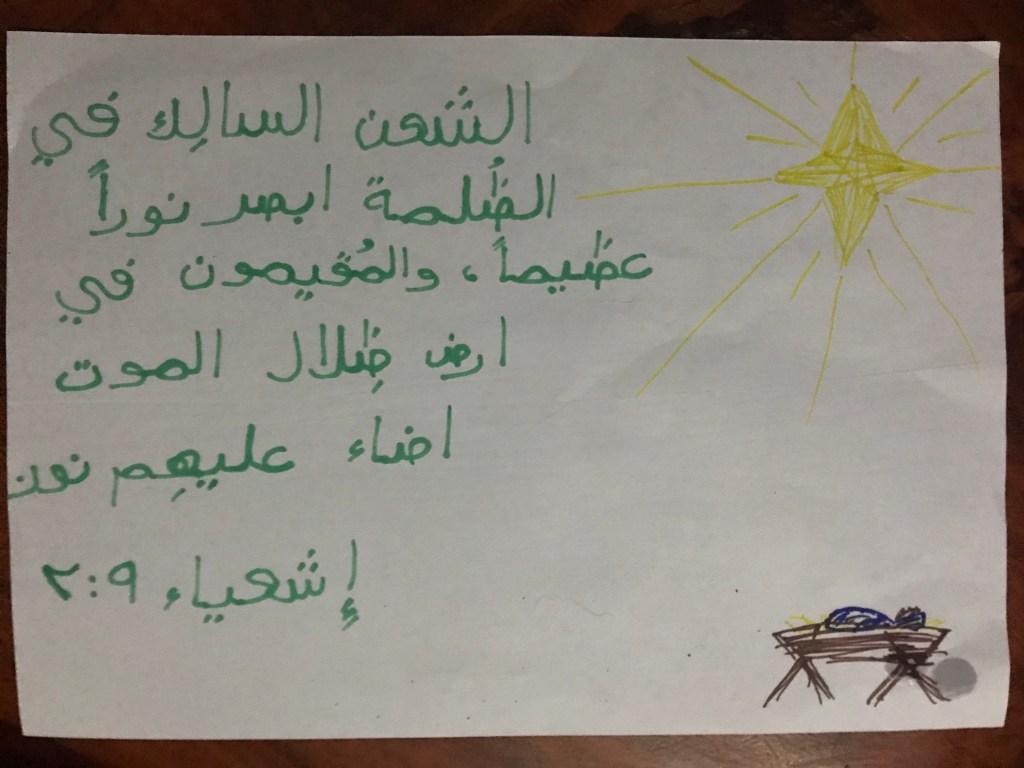
“The people walking in darkness have seen a great light; on those living in the land of deep darkness a light has dawned.” — Isaiah 9:2

Christ followers around the world celebrate advent because it teaches us to wait. As we wait for Christmas and imagine what it must have been like to live before our savior was born, we understand that the Christian does not wait passively. We hope. We prepare. We lament. We pray. We continue in daily faithfulness.

And this waiting—this numbering our days—teaches us holy habits. This season of anticipation for our savior’s birth trains our spiritual muscle memory to wait for our savior’s second coming in the same way.


This Christmas season has been a different one for me. I’ve spent Christmas overseas before: once for a brief visit in Cambodia and twice while I lived in Bulgaria. But my hot-climate Christmas was quickly followed by a return to the States and a wintry celebration back home with family. And my Bulgarian Christmases still surrounded me with snow, Christmas trees, carols, hot cocoa, and sweaters.

Christmas this year is on the equator, and the thriving palm tree just outside the front door dwarfs the fake Christmas tree just inside it. The only Christmas carols I’ve heard are the ones I played myself on the piano or from Spotify. I knew properly celebrating Christmas would take an extra effort when things feel so different, so I over-decorated and picked advent Bible readings to add to my normal quiet times. Little did I know how much my African context and regular readings in Kings would prepare my heart for advent all on their own.


I interact with refugees every day. Their heartbreaking situations are often normalized and mundane for me, but the heaviness slowly wears on you. It bows your back and puts a damper on your spirit. We talk about the hope of Christmas. I’ve shared my favorite Christmas verse from Isaiah about how a people walking in darkness will see a great light. But the reality is that I live in a land of lament among a people greatly acquainted with suffering. They carry with them an infectious ache for healing and a world made new. Deep in their spirits they yearn for great tidings of comfort and joy, and peace on earth to all mankind. Their longing for advent—for the savior’s coming—is not artificial or put on in any way.


Early in December I read 2 Kings chapter 7, which is a story from the siege of Israel. With Syrians at the gate and the last of the food gone days ago, the people were desperate. They ate donkeys’ heads, doves’ dung, even their own children. In that hopeless hour, God gave the people a sign to remind them he was with them: the next morning not only would the city have food staples they hadn’t seen in days, this food would sell for fractions of its normal price.

Sure enough, two outcasts with nothing to lose left the city that night to seek out the enemy camp. What they found was a ghost town. Provisions scattered, tents left standing, not a soul to be found. The Lord had frightened off the enemies with sounds of heavenly chariots. The men who found the camp gorged themselves on food and hid valuables they found free for the taking. But in the midst of their delirious joy, one had the presence of mind to say to the other, “What we’re doing is not right. This is a day of good news and we are keeping it to ourselves. If we wait until daylight, punishment will overtake us. Let’s go at once and report this to the royal palace.”

Those lines hit me like sack of flour. I decorate and celebrate Christmas in the midst of great darkness. I have good news! Great news of a savior born and a lost world saved, of comfort and joy, of hope for all mankind. Am I keeping it to myself? When the sun dawns and our savior comes back the second time, will I have shared this life-saving hope with the same conviction and urgency the men from the story shared their happy news with a starving people?

The truth is, refugees understand the waiting of advent, just like the men from the story did. They know what it feels like to wait for hope to come, straining their eyes to see from when or where help will arrive. They feel the world-weariness of the Israelites waiting for their savior, the Messiah, the Son of God.


An Arabic Christmas song I learned this year is about Emmanuel, God with us. We know our slow and haunting song, “O Come, O Come, Emmanuel,” and its words remind us of the pain and suffering God’s people endured while they waited, and the monumental task it was to keep their faith and hope alive in the prophecies God gave them to hold on to. But this Arabic song beautifully turns that idea to our African context.

Beautiful news on the earth,

It was the day He was born!

The Son of God, Emmanuel, the Lord’s redemption.

The sound of drums!

And angels cheering in the heavens!

And we below, full of need,

We wait for it…

The new covenant!


The song slowly builds and reminds us; now that our God has come, he will not leave us til the end. It expresses the ache with which we wait, the ache for the new covenant, for our God to be WITH us.

I have felt that ache this Christmas season. I’ve been reading 1 and 2 Kings, through seemingly endless cycles of kings who “did evil in the sight of the Lord” and “led Israel astray” or “caused Israel to sin.” As I read a collapsed version, generations of oppression, sin, and waiting pass in the turn of a page. The people dig themselves deeper and deeper into disobedience and suffering. As this horrible period spirals to its end, the people suffer each and every one of the covenant curses the Lord promised them should they stop following him and break his commands.

At the very end, a weary writer pens very matter-of-factly that the cities were captured. The people were carried off into exile away from their homeland. And all of this occurred because the people sinned against the Lord their God who had rescued them from Egypt. He had led them to the promised land and commanded them not to follow the religions of the people he drove out before them. But even so, the people built altars, temples, high places, and they worshipped the pagan gods and spirits. They broke the first covenant, turned away from God, and suffered their consequences.

I’ve simmered in these verses, these cycles of disobedience all December, just like a good Christmas apple cider simmers to take in all the flavors. I’ve felt the ache from the outside, the ache my refugee friends know so well. But I’ve also felt the ache from inside, from the inevitable brokenness sin leaves in its wake. Whether we live in exile or under oppression or just enslaved to sin in our lives, every human knows what it feels like to long for a new day, and new hope, a savior to swoop in out of nowhere to pull us out of the pit we’re in.

That is why we wait. Those are the emotions and the longing we feel leading up to Christmas as we wait not only to celebrate our savior’s birth, but for the righting of all wrongs that will happen when he comes a second time. As my heart yearned for a savior to lead us out of our mess, my advent readings led me to Luke 4:

[Jesus] went to Nazareth, where he had been brought up, and on the Sabbath day he went into the synagogue, as was his custom. He stood up to read, and the scroll of the prophet Isaiah was handed to him. Unrolling it, he found the place where it was written: “The Spirit of the Lord is on me, because he has anointed me to proclaim good news to the poor. He has sent me to proclaim freedom for the prisoners and recovery of sight for the blind, to set the oppressed free, to proclaim the year of the Lord’s favor.”

Then he rolled up the scroll, gave it back to the attendant and sat down. The eyes of everyone in the synagogue were fastened on him. He began by saying to them, “Today this scripture is fulfilled in your hearing.”

Those words of hope must have echoed in the silence of years of aching and waiting. This was good news indeed.
TGIF

Friday morning between 4 and 5 I woke up to a break-in happening right outside my bedroom window. Not much was taken. He didn’t get into the part of the house where I was. No one was hurt. Teammates were willing to come over in the middle of the night to help me feel safe and sort things out.

Later that morning, I had my first language exam. I expected a progress report that would tell us what areas I needed to strengthen and how far along I was. But instead I tested out of full-time language, with less than 7 months of cumulative classes. Our benchmark to test out is Advanced low. I was scored two levels higher, at Advanced high, in all categories except for the two that were Superior—the highest level possible. Like, native speaker fluency. In Arabic. A couple days later and I’m still in shock.

And if anything describes the emotional roller coaster this last month has been, those two events do. Friday was a bouquet of adrenaline, too many emotions for one tiny body, numbness, confusion, and exhaustion. I didn’t cry at the break-in, like a normal person would. Oh, no. I cried after my team leader told me what my language score was. Like a crazy person. And they weren’t happy tears. I have a complex about being a know-it-all, a desire to have genuine empathy and encouragement for people struggling to learn, and I hate even the implication that something I’m good at makes people feel uncomfortable.

I tested out on the same day two other ladies on my team did, and they have worked their tails off to get where they are, and sacrificed so much. I felt ashamed: ashamed that I hadn’t had to work as hard or as long. And I still don’t entirely believe the test results, even though a stranger and an acquaintance administered the test. I know how much I still don’t know, and the score makes no sense to me. So from some lethal combination of shame, adrenaline, exhaustion, and some twisted self-pity, I sat in my car and sobbed.

Don’t ask me how that makes logical sense. It doesn’t. It makes as much sense as any sin or brokenness the Enemy throws at us to attack our minds, because that’s exactly what was happening. In the aftermath of THEMOSTEXCITINGFRIDAYIVEEVERHAD, the Lord has been gracious to help calm my mind, to help me rest in him, and to give me clarity and assurance of his presence.

First of all, before I could even think straight, the Lord was already surrounding me with love, like a great big hug from the Body of Christ he’s put around me. So many members of my team gave me actual hugs, encouragement, exhortation, and genuine congratulations. My Sudanese friends literally danced for joy, helped me laugh, and told me they never doubted how the test would go. Friends and family sent messages to help me work through the shame and try to open my eyes to what a wonderful gift my test results were. Ugandan friends expressed so much sorrow at the break-in, physically grieving with me and helping me find words for the violation I felt. And ALL of these friends redirected my focus to the Lord who gives good gifts and gives them differently across all the members of his Church. It takes a village, folks. Africa has given such a richer meaning to proverb. But all I know is this single girl wouldn’t be in her right mind without her village.

MAN, am I blessed. God threw some foreshadowing into my day just for grins and giggles. During my test, one of the topics I had to talk about was my friends around the world. Even when I wasn’t paying attention to what was coming out of my mouth, the Lord was having me list people to be grateful for. He reminded me of how many kind, sacrificial, and loving friends I have—here in Uganda from so many different countries and cultures, in America from so many different states and contexts, and friends around the world who are in this same, roller-coaster expat missions life.

The Lord reminded me that HE is the one who has provided the people around me. And HE is the one who is stable when my life feels anything but. He is good when everything is changing around me, and it’s only the blessing of his love and goodness to me that carries me safely through the low times and the high times. I’ve been reading lately through the Kings. I’ve seen the same roller-coaster of faith in their lives. King David had so many ups and downs, but after every time he crashed and burned, in the middle of every blessing he received, he praised God. He constantly reminded himself of God’s presence and lived a more God-honoring life because he intentionally brought himself into God’s presence even when it was uncomfortable.

David was blessed above and beyond what he deserved, because God delights in showing grace and mercy. Solomon came along and was the wisest man the world has ever seen. God gave him discernment, the reverence of the world, riches beyond compare, and fame beyond imagining. But when Solomon turned his eyes from the Lord who gave him these gifts to the gifts themselves, he stumbled and fell. And the Lord took his kingdom and shattered it in consequence.

In church this morning our sermon was about the same thing. Peter walked on the water to Jesus, but when he shifted his focus from his savior to the problems he needed saving from, he began to sink.

Friends, it is SO. EASY. to fall away. You get distracted for one second from intentionally dwelling in God’s presence and you’ve forgotten to praise, forgotten who deserves your gratitude, forgotten that your savior is bigger than both the waves around you and the blessings he’s given you.

If anything, that’s what THEMOSTEXCITINGFRIDAYIVEEVERHAD has taught me. My loving heavenly Father had already prepared an answer for the burglary before it even happened. And my language score wasn’t by accident, isn’t something to wallow in or hide or feel ashamed of. It is simply a gift he gave to be used to further his kingdom. I cannot tell you how my excitement has grown as I’ve allowed myself to imagine actually becoming fluent. The opportunities to communicate, to share Bible stories, to disciple, to learn culture and build friendships in deeper and more meaningful ways are endless. This gift doesn’t need to be buried in a hole, but invested to bring great returns for my Master.

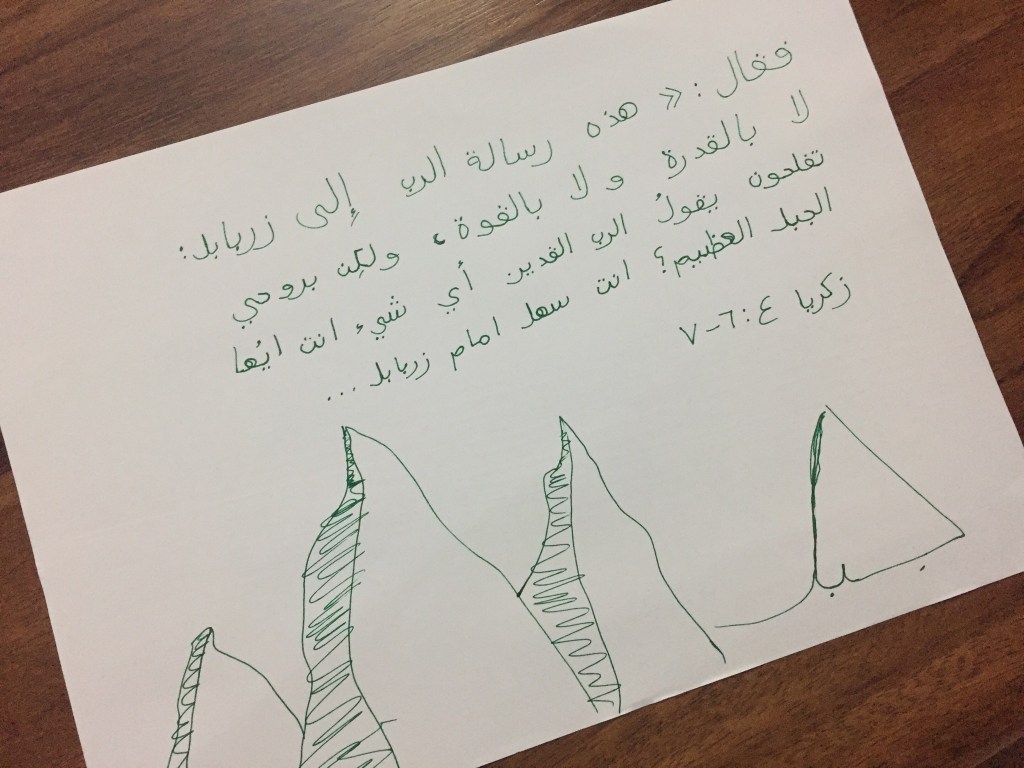
A long time ago I had some artwork on my computer desktop screen of the golden lampstand and olive trees Zechariah describes in chapter 4 of his book. After the angel shows him this vision, he asks what it means. The angel answers him with the Lord’s message that the Temple of God’s presence will be rebuilt. And it will be rebuilt not by might or by power, not by skill or by endurance, not by determination or ability, but by God’s Spirit. You can almost hear the angel laughing as he delivers the message. Who are you, mountain, to stand in the way of the Lord’s work? You will be smoothed out into a plain. God’s work will be completed by HIS power, and anyone who has despised or despaired at the small things that have happened along the way, they will rejoice.

It’s that way with all of God’s work. No storm on the sea of Galilee, no Old Testament dynasty, no break-in in Arua, Uganda, no failed language exam, no road block of any kind can stand in the way of what the Lord wants to do. It’s our job to sit back, have faith, and rest in the power of the Lord’s Spirit. Don’t despair at the small things friends, don’t despise the obstacles that seem so big, and don’t get yourself bent out of shape at the good things you think you’ve done either. It’s all the Lord. He wins the battle every time, and we just get the blessing of being a part of it.

To remind myself of those very words, I made a little Scripture art for my wall:

Then he said to me, “This is the word of the Lord to Zerubbabel: Not by might, nor by power, but by my Spirit, says the Lord of Hosts. Who are you, O great mountain? Before Zerubbabel you shall become a plain.”

1F95CDE8-7DC7-4612-A7FC-60AC3914CD12.jpeg