Tag: Bible storying

Mountain Snapshots pt 2

I wish I could bring you all with me when I go to the mountains, so you could see what I see and hear what I hear. But this time someone joined our group with a photographer’s eye and a camera to channel it. I’ll throw in some of his pictures below, but I wanted to give you some “mental snapshots” to go with them—thoughts and moments I’d always want to remember if I never saw this place or these people again. 


Sundays on these trips are different days. They brim with activity like every other day, but they’re unpredictable and often lead to unexpected adventures. Every “teaching” day I wear a more comfortable dress and headwrap, balancing cultural respect with functionality. But on Sundays I break out the Sudanese cultural dress, a toub. Meant to be worn over a full set of clothing, this long piece of fabric wraps multiple times around the body to cover legs, torso, arms, and hair in one unbroken block of color or vibrant pattern. I don’t have to teach or lead on Sundays, so my decreased maneuverability and comfort in the sometimes 7-layer getup is an acceptable sacrifice to make for all the sweet smiles from strangers who can see my clothes, hear my Arabic, learn my local name, and immediately understand I value them and their culture. 

This Sunday I don an all-black under-layer of leggings and a long-sleeved leotard, so nothing will bunch or twist under the layers of  toub wrappings. Then I choose the tie-dye purple and green toub that’s more gauzy and breezy than some—a gift from a friend used to wear it herself in hotter desert conditions than this. When everyone is ready for church we cut across a couple fields, tramping on the footpath I could never have picked out for myself while hiking my layers up so I don’t drag half a field of dried grass and stickers into church with me. We arrive and worship with our brothers and sisters through a beautiful service in a simple building decorated with fresh-picked local flowers hanging from the roof supports. A few holes and pockmarks in the walls from the last war’s aerial bombardment makes the building an even more beautiful testament to God’s protection. 

As we mingle in the yard after church the typical jokes follow about my positive marriage prospects if I keep wearing a toub, and theatrical surprise played for laughs at my Arabic comprehension when someone suggests a son or a nephew who might be about my age. Laughing, I hold the pumpkin our teammate was given as thanks for sharing the sermon today, and clumsily try to balance it one-handed on my head to demonstrate the poor excuse I’d be for a working Sudanese wife. As we walk back home I unwrap one torso-encumbering layer of the toub and re-wrap it to throw it over my shoulder in a less formal style women wear when they have work to do. I’ll wear it that way for the rest of the day for greater ease of movement. After lunch, a friend calls out “hey Kandaka!” as I pass by. He’s teasingly comparing me and the toub over my shoulder to the iconic 2019 Sudanese Revolution picture of a woman called Kandaka. She herself was named that after the long Sudanese historical tradition of female leaders and cultural nurturers who moved and shaped a people with their stories. You’ve likely read about a Kandaka (or Candace) in Acts 8. A crooked grin immediately splits my face at the flattering comparison, and that I caught the deep cultural reference. 

Not long after a relaxed Sunday lunch, we’re given a few minutes’ warning before a trek to go see a building site for a hoped- and prayed-for new Bible college. Unsure of how long the trip will take, I wad up my body and my layers in the half-seat above the gear shift in a truck older than me, sandwiched between the driver and my teammate for what turned out to be a three hour excursion. The bed of the truck is a clown-car of people, and two motorcycles flank us carrying those who couldn’t cram into the truck bed as we drive through gardens and dry river beds up to the crown of a mountain. We clamber around on the mountaintop for a while and pray over the site before we descend to explore the flash flood river bed and the new springs that opened up last rainy season. 

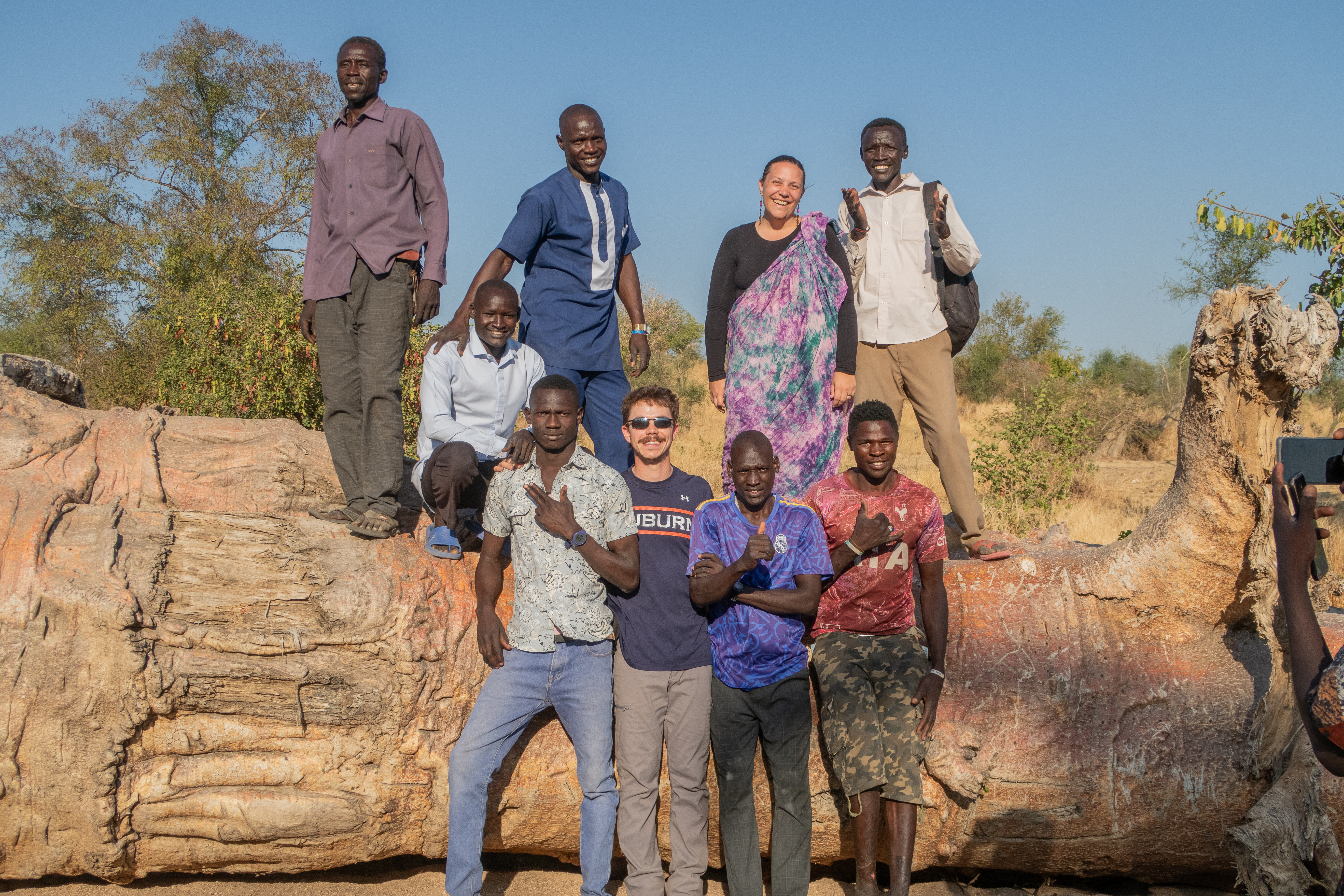
It was with pride that I managed almost as well as a Sudanese woman would in her own dress, and only caught my layers once on some fallen acacia thorns. In the dry riverbed valley below the brow of the hill, we see a baobab trunk that was swept down in last season’s flood. I still haven’t gotten over my giddy excitement of seeing these massive, distinctive-looking trees for the first time in my life in this area, so I rush down to feel its smooth, cool bark and branches I could never reach in standing trees. The youngest guys clamber up the side of the massive fallen trunk, and I know instantly I can’t miss this opportunity. With a moment to assess the physics involved, I kick off my flip flops and flex my toes in the sandy pea gravel underneath my feet. I hike up my layers and to accompanying shouts of “Go slow!” and “Don’t let the white woman fall!” I hop up the side of the ancient tree, using gnarled knots in the bark for hand and foot holds, with my skirts gathered in one hand. Everyone nearby swarms back up the tree and poses for a picture with the white girl in the local dress who miraculously avoided face-planting.

Photo credit: Johnny Rainey
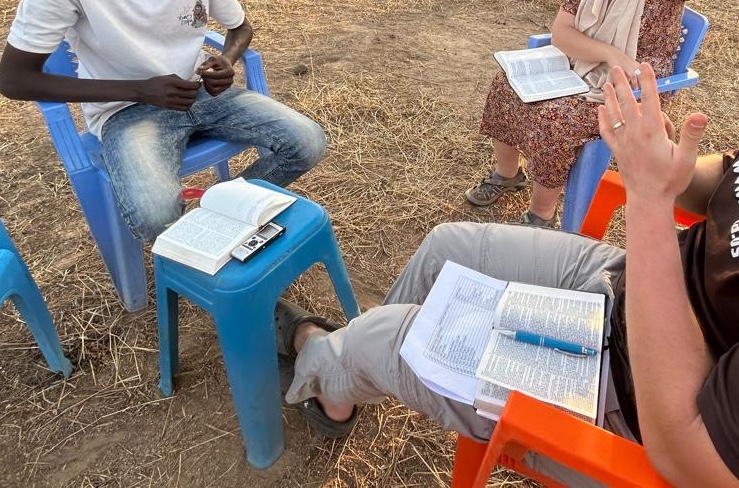
Photo credit: author

Toward the end of the week, I sat again under the same patchy shade of the same scraggly tree with the group of two young men. One has faithfully shown up to work every time we’ve visited. He’s my youngest brother’s age, and he knows me by my Arabic name that means “big sister.” This time we’re listening to the story of the woman caught in adultery from John 8 through translation from their language to Arabic. Every detail is accurate, and spit out in quick succession. Another deep story about how Jesus interacted with women who were publicly shamed, rattled off like a speed recitation. 

I take a beat to compose my thoughts and decide where to start to both compliment their good work and encourage them to go deeper and tell the story with more faithfulness to all those layers. But I didn’t have to worry. Perhaps more comfortable after we talked through some taboos earlier, my “little brother” blurts out, “where was the man?” A slow smile grows on my face as he continues. “If she was caught IN adultery, there must have been a man. Why didn’t the religious leaders bring him in too?” He has some theories that he rattles off, and I offer some more. But we dig into the story so he can see the way the religious leaders brought the woman there as bait for a trap for Jesus, to try to get him to say something against Moses and the Old Testament law. 

But I go back to some of the details in the story that explain some things between the lines. Miraculously God gives me the Arabic I need to communicate the nuance of this story. But I still don’t have the vocabulary to communicate the complex web of shame in this story that translates directly into these two young men’s culture. I explain that the story begins at sunrise, and how it was possible the woman was caught and brought in some state of undress when she was paraded out in front of everyone there at the temple to worship. I readjust the part of my headscarf hanging down over my torso, matching the unconscious expression of any local woman who feels exposed emotionally or socially. I hope my actions and gestures fill in for some of the nuanced vocabulary I’m missing, but before I know it, I’m up on my feet to explain the story spatially. 

When the religious leaders brought her into the temple, they treated her like she was only an object for their trap for Jesus. To answer the original question, they’re obviously thinking about incriminating Jesus more than incriminating the man she was caught with. But in the process, they make her the object of everyone’s attention. I stand in the middle of the circle, pulling my headscarf to cover more of my body. But then they ask Jesus, and not only does he take a long time to answer, he bends down and begins mysteriously writing in the dirt. I grab the shoulders of my American teammate, to use him as a stand-in for Jesus. Jesus could have immediately given them a wise answer, but he delayed. I step out of the circle and stand behind my teammate, with him between me and the young men. Now, everyone at the temple was looking at him and waiting for an answer. He was covering this woman and her shame, even though she had sinned. And not only that, he took some of the shame from her. When he didn’t answer, everyone looked at him and wondered if he could give a wise answer or if the religious leaders would humiliate him.

We continued telling the story with me walking through its paces, showing that Jesus chose to forgive this woman’s sin instead of condemn it, and to cover her shame instead of expose it. At the end, the young men had huge grins on their faces because they saw how Jesus has not fallen in line with heavy cultural shame directed toward women, but turned it on its head in order to protect them. I was glowing inside at the chance to be their big sister and tell them things other women aren’t socially allowed to. I was honored and humbled to help disciple them through the cultural expectations they face, so they can break the mold and be better brothers and fathers and husbands one day. 

Photo credit: Johnny Rainey
Photo credit: author

Mountain Snapshots pt 1

I wish I could bring you all with me when I go to the mountains, so you could see what I see and hear what I hear. But this time someone joined our group with a photographer’s eye and a camera to channel it. I’ll throw in some of his pictures below, but I wanted to give you some “mental snapshots” to go with them—thoughts and moments I’d always want to remember if I never saw this place or these people again. 


The sky slowly starts to sprinkle with stars as the sunset glow dims in the west. We often look for planets or constellations half-remembered from childhood. With no light pollution for miles around except what can be produced by flashlights or anything run from a solar panel, we see more stars here than I’ve seen on all but a few nights of my life. 

I briefly sit at a plastic table surrounded by plastic chairs filled with friends from a nearby mountain tribe. I am content to listen to the percussive rhythm of their language, set to a background of night noises: the muted crunch of gravel when anyone walks by, the evening wind blowing gently through the standing grasses of late dry season, the multi-layered soundscape of birds and bats and insects. 

One of the men notices me looking at the stars and breaks off his part of the conversation to invite me to participate in English. I lower my eyes and notice his smile glowing bright in the late dusk like the stars overhead. I ask him if the stars look like this at his home. Of course they do. Why would they look any different? To dissolve the confusion I explain about Kampala city lights and smog. I gaze back up, trying to remember the stories of the Greek heroes and which patterns of stars belong to each one. I tell him my people have stories about the stars and ask him about his people’s star stories. But they aren’t about heroes. Their stories are about which stars to use to find home, and which ones tell you when it’s time to plant, or when the rains are coming. 

The next time I see his smile glowing that brightly, he’s beaming at me and saying goodbye from the back of a truck bed, where he’s crammed in with at least 10 other people to start their journey home. That mental snapshot was a confused tangle of images in my head, like all the arms and legs squeezed into the back of that truck. A firm grasp that is the cultural equivalent of parting handshake from a calloused farmer’s hand. I don’t see the face it belonged to before the hand disappeared back into the tangled mass of people. Confused goodbyes shouted in English and Arabic and local languages. And that LED smile of his. I didn’t know it at the time, but he was glowing brighter than normal because a few hours before climbing into that truck bed, he’d become a new brother. One of the first of his people to follow Jesus. 

Photo credit: Johnny Rainey

Our plastic chairs are arranged in small circle, crunching in the dead remnant stalks from the last harvest we’ve laid flat with our fidgeting feet. The spotty shade from the dry scraggly tree we sit under has rotated a few degrees around the trunk without us, and I can feel my forehead starting to sunburn. I tug at my headscarf to rearrange it to protect my face a little better. The recorder clicks on an off, an off-kilter rhythm of their drumming Darfurian language, an Arabic translation of it, and my stilted clarifying questions in Arabic or English. 

The story, about the bleeding woman from Luke 8, falls flat. It’s told accurately, with only a few minor errors to fix or details to clarify. But it has no life to it. I stare at the ground, thinking and praying about how to communicate and motivate them—how to explain to this group the massive weight of this story for women who will hear it, and how formative it can be for the men who should love them like Jesus loved this woman. I look at the shoes that make up the rest of the circle, all men’s shoes, and I feel that familiar separation begin, like one cell splitting into two under a microscope. A complete separation of two things that were once together and whole. My world is not theirs. And as much as I may more easily be able to relate to them as a cultural outsider, an even wider gulf exists between them and their women. Their women have been the target of genocidal war-time rape for two generations. And a woman who suffers like this must keep quiet and hide what she feels to be shame because if it becomes known what was done to her, she is often viewed as unclean. She is commonly seen as unmarriageable to her people and she can be cast out so her ‘defilement’ doesn’t negatively reflect on the community that couldn’t protect her. 

I feel my “otherness” in a community that often treats women this way, and second-hand shame and brokenness bubble up inside of me. I gingerly speak to everyone’s shoes, not daring to make eye contact over this taboo topic but desperately wanting them to understand. “In your people, there are women like her. There are women who feel shame, who feel dirty… who have been raped…” I let the statement hang in the air. “They need to hear this story. They need to hear in their own language for the first time that Jesus listened to this woman.”

I keep staring at the shoes and the dry broken stalks. I’ve spoken in simple English because I didn’t trust my Arabic. And the team’s American coach has heard and now chimes in, “Do you personally know women in your town where you live who have been raped during the war?”

In complete shock I look up, eyes wide, and hiss under my breath in quick English I hope they won’t understand, “They can’t talk about it. It’s taboo. It will bring shame to admit that has happened to any woman they know.” But when I look up, I don’t see the separating gulf I felt between the men and me. The two young men aren’t staring away, outside of the circle, in embarrassment. They’re looking at me. And listening. With an effort of will, I pull my mind and heart back into that circle, back between two young men who want to become more like Jesus in the story, and want to do better as they grow up to become spiritual leaders among a tribe with growing numbers of new believers.

My teammate’s pastoral question optimistically crossed a cultural line and prompted them to question assumptions I feared I couldn’t address outright. Ready to let God’s word teach for itself in this vulnerable moment, I review the story: how Jesus made an important man wait while he listened to the woman, how he called her “daughter” like she was welcome in his family, and how he publicly praised her faith to be healed in front of the whole crowd. The next recording of the story I listened to was full of life and hope. 

Photo credit: Johnny Rainey

Habakkuk Storied

Sometimes the words in our Bibles become stale. I don’t mean that the words lose any power; I mean that we become so familiar with the cadences and phrases they lose some of their freshness for us.

Recently as I was studying justice, lament, faith, and abiding in the presence of God through difficult circumstances, I landed in Habakkuk. This short Old Testament book deals deeply with each of those topics. To ‘freshen up’ the words for myself, I went through the book phrase by phrase to soak in the meaning and re-word the Scripture as if I were preparing to learn it well enough to share Habakkuk’s call and response with the Lord as it was meant to be heard and shared originally. Below you’ll find my manuscript for a ‘storied’ version of Habakkuk, with no content changed from the Biblical narrative and only small phrasal changes. I hope you enjoy a fresh look at this incredibly timely book of the Bible. Try reading it aloud to yourself to give the text some extra life.


The prophet Habakkuk received this burden:

Habakkuk: God, how long do I have to call for help and you refuse to listen?

I yell for help: “Violence!” but you don’t save?

Why do you turn my head and force me to watch injustice?

Why do you let sin pass?

Ruin and hurt are in my face: there is too much fighting and division.

Because of it, the law is impotent and frozen, and right never wins.

The evil rope up and surround the good so that right and fair become crooked.

God: Watch the world and be completely shocked.

I’ll do something in your time you wouldn’t believe if I told you.

I’m grooming the Babylonians — merciless, rude, and unpredictable —

to burn through the earth and make foreign homes their own.

They fill people with terror, make their own rules, and make a name for themselves.

Their horses are faster than cheetahs and more fearless than wolves at nightfall.

They come at top speeds from farther than the eye can see.

They swoop down like a hawk to the kill, focused only on death.

Their armies oppress like a desert wind, catching hostages like dust.

They lecture kings and humiliate leaders.

They laugh tat fortresses and move the earth itself to conquer them.

They barrel through like wind with no obstacles, convicted men who deify their own power.

Habakkuk: Lord, haven’t you been around forever?

My God, my perfect God, we can’t die.

You elected them to carry out retribution.

Steady and Unchanging One, you picked them to punish.

Your gaze is too pure to look on evil.

Why do you let them betray?

Why do you sit quietly by while evil people eat up others better than themselves?

You make people like fish in a barrel, like fish with no leader, no one in charge.

The evil enemy catches all of them in traps,

lures all of them in, nets them with ease. 

So he is giddy with delight, and he worships his net.

He offers it food and rituals because his net lets him live like a king and feast like one too.

You’re going to let him keep pillaging the sea — wiping out empires ruthlessly?

I will be at my station on the watchtower of the defensive wall.

I’ll look for his answer, and for how I should reply to these concerns.

Then the Lord replied:

God: You’re going to want to write this down, plain for all to see and hear.

This message is ready for the right time — it’s about the End, and this one will prove true.

Even if it’s a long time coming, wait for it.

It is certain to be on time.

Look at him, all big-headed—he wants crooked things,

But a good man will live by faith—

Alcohol is a traitor to him. He is proud and never sits still.

He’s as hungry as the grave and like death, he’s a bottomless pit.

He gathers all the nations and steals from all the people to make prisoners of them.

Won’t all these people want retribution, and mock him with humiliating sarcasm:

“Look out, if you hoard loot and get rich manipulating people!

How long will you keep this up? Won’t the people—who you owe—rise up?

Won’t you shiver when they wake up?

Then it’ll be your turn to be the victim, 

because you have looted many countries.

And the people you overlooked will loot you.

The blood you spilled was from people.

You have flattened fields and cities, along with their people.”

“Look out, if you build your kingdom on foundations of slavery and injustice,

To try and build it high out of reach,

so you can dodge the claws of destruction!

You planned to destroy many people,

so you shamed your home and gave up your right to life.

The stones in these walls will testify against you,

 and the wooden beams will affirm them.”

“Look out, if spilled blood has built your city, and crime founds your town.

Hasn’t the Lord said peoples’ work just feeds the fire,

and the countries wear themselves out for nothing?

Regardless, the full earth will know the glory of the Lord,

like the oceans know water.”

“Look out, if you push drinks on your friends,

refilling till they’re drunk so you can feed your hungry eyes with their naked bodies.

You will be full of shame instead of triumph.

Take your turn! Drink and be naked!

The Lord’s strong hand brings the cup to you, and disgrace will cover up your power.

Your violence to Lebanon will sweep you away,

and your slaughter of animals will haunt you.

Because you have drained human blood—

you destroyed fields and cities still full of people.”

“What is an idol worth, since it is only carved by man?

What about a figurine that only reinforces lies?

Whoever makes them trusts the work of her own hands.

She makes mute godlets. 

Look out, if you try to make wood come to life

Or to make stone wake up.

Can it lead you?

It’s covered in gold and silver—it doesn’t breathe!

But the Lord is alive and well in his holy temple.

Let the whole earth fall silent for him!”

The prophet Habakkuk’s prayer:

Habakkuk: Lord, I have heard the stories they tell about you.

Your work has me stock still with amazement.

Do these things again in our time!

Let people these days know your works!

Remember to show mercy in your retribution.

God comes in holiness from the south as of old.

His throne-glory spreads over the skies

and his court-fanfare sounds from all the earth.

His radiance like sunrise gleams from his hand where he hides his power.

Plague makes a way for him, and disease carries his train.

When he stands, he shakes the earth.

Under his gaze the nations tremble.

The time-strong mountains crumble,

and the time-worn hills fall in on themselves.

He has eternal work.

Ethiopia’s tents are disarrayed, and Midian’s homes are distressed.

Lord, were you angry at the rivers?

Did the streams provoke your rage?

Was your wrath toward the sea when you rode with triumphal horses and chariots?

You unwrap your bow and call for endless arrows.

You carve the earth with rivers and mountains writhe under your glance.

Rushing water roars by and raises waves high.

The sun and moon in the sky are paralyzed

as your arrows glint and fly, and as your spear flashes lightning.

You march through the earth with rage and your wrath culls the nations.

But you sought out your people to deliver them.

You rescued your chosen one.

You trampled the leader of the wicked land and stripped him of everything—head to toe.

You crushed his head with his spear when his warriors made their move to scatter us.

They gloated as they prepared to prey on the weak in hiding.

Your horses disturbed the sea and frothed the wide waters.

I heard the stories and my heart pounded.

The words made my lips tremble.

My bones rotted hollow and my legs quivered.

But I will patiently wait for the day of disaster to crash over our invaders.

If the fig tree doesn’t even bud, and the grape vines hang empty,

If the olive harvest fails and the farms lie bare,

If the barns shelter no sheep and the cow stalls are vacant,

STILL the Lord is my joy:

I rejoice in my Savior.

My strength comes from the powerfully ruling Lord.

He gives me stable footing like the deer

And prepares me to climb the summit.