Tag: goodbyes

Mountain Snapshots pt 3

I wish I could bring you all with me when I go to the mountains, so you could see what I see and hear what I hear. But this time someone joined our group with a photographer’s eye and a camera to channel it. I’ll throw in some of his pictures below, but I wanted to give you some “mental snapshots” to go with them—thoughts and moments I’d always want to remember if I never saw this place or these people again. 


Another day of teaching through until dusk blurs the words in our Bibles. I walk slowly back to the room I share with my teammate and pause at the foot of my bed, my mind too numbed from the long day to make a decision quickly. I glance toward the concrete room with the drain where we take our evening bucket baths, and I’m too tired to begin that process at the moment. Instead I just pull off my headscarf since I’ve finished teaching for the day. I walk back outside intending to find a chair to drop into. I hope to enjoy a still and quiet moment, with the rising evening wind cooling my (finally) bare head and neck while I think through the day we’ve almost finished. 

I scan the clean-swept yard for a chair near enough a group that no one will assume I’m alone and need company, but at enough distance I can absent myself from the conversation I have no energy for. My eyes land on a perfect spot and I make a bee-line for it, but before I reach my destination one of our friends and workshop participants crosses my path. A smile springs to my face automatically, followed by the traditional greeting and hand-grasp. This friend speaks no English, and I often have a harder time understanding him through his quiet tone and slightly different accent. My selfish desires still have my eyes cutting toward that chair and its promised moment of tranquility as we continue through the socially required greeting process. But then I take a moment to actually look at his face in the gathering dusk. He never smiles, but there it is, unmistakable on his face. And he’s often quiet in groups, yet he chose to initiate this conversation with me. 

Something feels different about this interaction, and about him, so I shake myself mentally, check my selfishness, and redirect my mind and heart to genuinely engage with him. He is a respected and capable farmer and herdsman, so I ask about his home and land. As he continues through the small talk that smile lingers, and he seems almost… joyful. For a man usually grim-faced and close-mouthed he is unusually lively. I have never gotten much response from him before when I ask about the Bible stories that make up our days’ work, but his mood is different than I’ve ever seen it before, so maybe it’s worth trying again. 

I ask one of my favorite questions: “What is your favorite story we’ve learned?” The answer speaks so much about personality or spiritual state or personal connections to God and his word. But my friend’s answer halts me mid-conversation. “The story of John’s Vision,” he says, referring to a story we’ve worked on from Revelation. Nearly twice the length of most other Bible stories, this one notoriously gives rise to fatigue and complaints from our groups as they struggle to remember all the details correctly. Just two days ago for our morning devotion we heard the story told and then acted it out together to help our bodies and emotions remember the story as well as our brains. As much as amateur drama usually elicits self-conscious or amused giggles, when we do this story the atmosphere is unusually heavy. With Muslims and Christians in the group, reenacting moments like when those who followed Jesus in life are judged differently from those who didn’t, or when Satan and those who didn’t follow God through Jesus are thrown in the lake of fire remind us of eternal stakes. 

Shocked that my usually gloomy Muslim friend would tell me with a broad smile that this is his favorite story, I ask him again, wondering if I misunderstood. “You mean the story about the End, with Satan and the lake of fire?” “Yes,” he reassures me. Still confused, I ask him why that’s his favorite, or what he likes about it so much. “Because everyone who follows Jesus will be with God,” he answers smiling, like it’s the most obvious thing in the world. And God himself will wipe away our last tears. 

Our conversation was interrupted when someone called him away. But I stood there frozen a few moments longer, my solitary chair forgotten as my own smile grew and I began to consider what his answer might mean about his own thoughts about Jesus. A few days later I learned that new liveliness I saw in him was abundant life, springing up in his soul and overflowing because he’d decided to follow Jesus. 
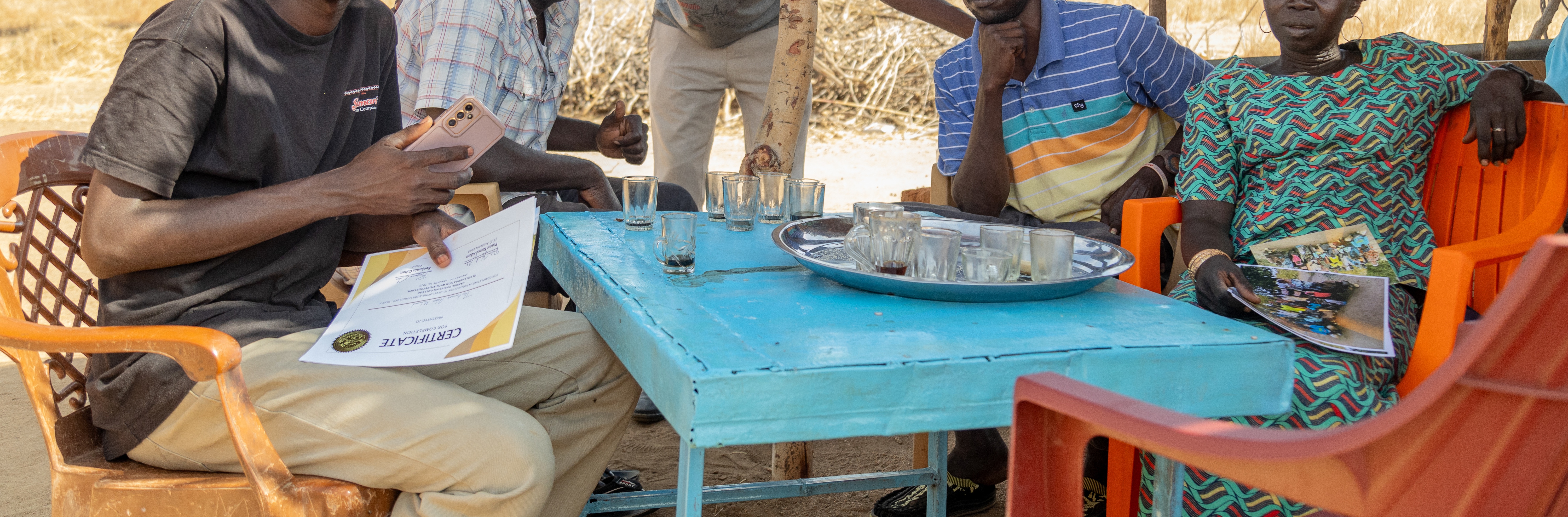
Photo credit: Johnny Rainey

On our last day, we leave before the sun is up. Before we all pile in the same truck that has ferried us back and forth for all our local travel, a crowd gathers in a semicircle. The bags are loaded in the bed and we stand in an awkward silence, loath to say goodbyes. A prayer is said for travel, and then we give the deeper greeting since we won’t see each other again for a while. Extend your right arm and place your palm over the friend’s heart opposite you while they do the same to you. Then drop your arm to grasp their right hand in a goodbye, or wrap that right arm around them first to pull them into a hug depending on your relationship. We look into each others’ sleep-swollen eyes in the gloom as we greet each in turn, and I try not to wonder when I’ll see them next or how long it will be or what hard times they might face in the meantime. 

I scrunch up over the gearbox again, angling my hips and legs to give the driver as much room to maneuver the gear shift as possible. It’s still warm from its long trip the night before, taking the first load of everyone home. For the first two hours the talk in the cab is quiet and sporadic. We watch the sun rise over these beautiful mountains and I am careful to take in the images—the ground terraced for farming, the ‘desert baobabs’ that burst with brilliant pink flowers, familiar spots where recognizable trees grow or where we’ve made pit stops before on the road. 

After we stop two hours in at a town the sun is fully up, and I decide to move to the truck bed. I’m given the spot over the wheel well, and someone insists on giving me the folded up blanket as a cushion for all the bouncing, even after I insist I have more built-in cushion than all of them put together. It would be a cultural sin not to offer (and receive) hospitality in this way. As we start moving, the three young men in the back with me at first seem nervous I won’t have the balance or strength to manage as we drive over the roads that are sometimes just scraggly rocky mountain faces. But I drape my forward arm along the rim of the truck bed and can maintain a light grip as we bounce along for the next hour. The curve of my back fits snugly around the lip of the rim, further helping to hold me in place, and I ride comfortably and enjoy the cool morning air and chance to stretch out my legs. 

We drive so slowly over these roads that we have no problem conversing over the road noise. We talk in spurts, shifting between English and Arabic, but I mostly enjoy taking in all the morning sights and sounds as we drive through villages waking up and beginning work. The children always do a double-take when they see the rare white woman in the back of the truck. Some run behind us, nearly all wave. My teammates and I jokingly call me a princess because of all the attention I get, like that folded up blanket currently saving my tailbone from bruising. But right now I feel like a princess in a parade waving back at all the children every few minutes, watching their faces break into massive smiles. 

The kids’ excitement at my obvious other-ness would seem to make me feel I don’t belong. The waving little knots of children overflow with an enthusiastic sing-song repetition of the word for foreigner or white person—kawaja—yelled out to announce to others to come and look. Some days being known known and called by this word instead of my own name grates on my patience and feels like a stiff arm keeping me outside the circle of the community. But today in the light of the golden-pink sunrise I feel a contented sense of belonging as we drive through roads and villages that have become curiously familiar through our repeated trips. As the conversation moves in and out of Arabic, for the most part I am able to follow its thread. I’m even able to interject with some of the history of the place, like a local telling newcomers the gossip about what happened at that bend of the road a year ago, because I drove past and saw it firsthand myself. 

The contentment grows as the conversation continues in Arabic, and no one pays me special attention or translates for me. I’ll always be in a middle-place in this community—on the fringe, but welcomed in as a familiar friend. Allowed to ride in the bed of the truck, but given the only blanket to help account for my difference. So the next time the children start a chorus of “ka-WAAA-JA!” I smile and raise my eyebrows at the group. “Do you hear them singing my song?”

Photo credit: author
“Desert Baobab,” photo credit: author

Wagon Wheel

167111B5-EFD3-4C95-A47B-1F3C7CC2161B

I have a wagon wheel tattooed on my leg. It’s a pretty permanent reminder of impermanence. I like to take pictures of it whenever I travel somewhere new, to keep a chronicle of all the places I’ve ‘parked my wagon wheels.’ But its meaning is so much deeper than that.

A few years ago I lived and worked with the Roma people in Bulgaria. Known and stereotyped for their nomadic, ‘caravan’ lifestyle, this community taught me a lot about transience. I learned what it is to make a home wherever you are, to not depend so much on a place and its things as on your people. I experienced life embraced by a ‘clan’ and accepted as family even though the difference in my culture and skin tone were as obvious as night and day. I felt all the hard goodbyes without a promised ‘see you next time,’ and all the joyful reunions and relationships that picked up right where they left off, no matter how much time had elapsed.

My ‘gypsy’ years taught me a lot about expat life. I live in a country that doesn’t match my passport, so I’m an expatriate, and I experience all the joys and sorrows, trials and triumphs attendant to this special lifestyle.

Being an expat means I know things can turn on a dime. Life can change drastically in a matter of hours or days, and you have to roll with the punches. It means I say a lot of goodbyes. It means I have built lots of rich relationships. It means I have friends in lots of different corners of the world. It means sometimes the people closest to my heart actually live the farthest away from me. It means having a go-bag in my closet. It means trying to monitor a sometimes overwhelmingly foreign culture for a few signs of ‘different’ that mean something isn’t right. It means being misunderstood and misunderstanding. It means stuttering along in the language of a friend. It sometimes means being utterly, nakedly, vulnerable and dependent upon the kindness of strangers and new friends. It means I build family fast and bond deeply but sometimes I hate myself for it because goodbyes are awful. It means opening my home to strangers because I know what it means to be welcomed in as one myself. It means a rollercoaster of emotions and changes. It makes for a wild ride.

This worldwide pandemic going on right now has really made the impermanence of expat life stand out harshly. In the past week alone I’ve felt the border crossings lock tight shut around me. I’ve helped friends, neighbors, coworkers pack to leave the country at the drop of a hat. After much anguish and many changed plans, they got out of the country on one of the last possible flights. I’ve stocked up my house in case social upheaval keeps me indoors. Unnatural crowd sizes made my skin prickle. I’ve fielded texts and calls from friends and acquaintances leaving that I didn’t even get to say goodbye to. I’ve kept a wary eye on emails from the embassy. I’ve played ridiculous games in the market shopping with friends to create some sense of lightness and normalcy. I’ve munched on a mendazi in town while counting heads to make sure I was spatially aware of my people… just in case. I’ve cried hard and laughed hard. I’ve stress baked until it seems like every surface in my house is dusted with flour. I’ve belted out my emotions singing along with “I’m just too good at goodbyes” and “all by myself” and “big wheel keep on turnin'” along with plenty of hymns and worship music as well.

This expat life can be an extra source of stress at times when everywhere in the world has more than enough stress to go around. But the flip side of that coin is that this life has taught me and better prepared me for such a time as this.

Coronavirus didn’t do much to remind me of the impermanence of life and home and relationships. I carry that thought always at the back of my mind and tattooed on my leg. I didn’t need a worldwide pandemic to firmly plant in my heart the truth that our home in this world is never promised, but that we deeply long for a permanent one with our Creator. In times of trouble my mind and heart already ask with Moses, “teach us to number our days, that we may gain a heart of wisdom.” My life carries a base level of urgency already because I know not to take the days for granted and to make the most of relationships and opportunities here and now. As volatile as life is right now, and as much as my whole world changes sometimes by the hour, I have the immovable hope and assurance that my real home doesn’t change. My heavenly home waits for me just the same, and the parts of my life given to build up that kingdom will not go to waste—no matter what happens in the world around me.

Another huge comfort is knowing that God is not surprised by times such as these. No matter where you are trapped or stranded or locked down, God is there with you. When God appeared to Ezekiel and the Hebrew exiles, he chose to show himself as a wheel. Wherever we may be, and however far from home and family it feels, God reminds us that he is an ever-present, traveling God. He sees us. He knows us. And without moving himself, he is with us wherever we go. He was there before us and he’ll be there behind us. And that is a great comfort to this expat heart.

As I looked at the living creatures, I saw a wheel on the ground beside each creature with its four faces. This was the appearance and structure of the wheels: They sparkled like topaz, and all four looked alike. Each appeared to be made like a wheel intersecting a wheel. As they moved, they would go in any one of the four directions the creatures faced; the wheels did not change direction as the creatures went. Their rims were high and awesome, and all four rims were full of eyes all around.

When the living creatures moved, the wheels beside them moved; and when the living creatures rose from the ground, the wheels also rose. Wherever the spirit would go, they would go, and the wheels would rise along with them, because the spirit of the living creatures was in the wheels. When the creatures moved, they also moved; when the creatures stood still, they also stood still; and when the creatures rose from the ground, the wheels rose along with them, because the spirit of the living creatures was in the wheels.

The End

Well, I was going to post today during my layover in Amsterdam, but after I typed everything up I found out that I didn’t have internet. 🙂 So, enjoy!

I am posting this blog from an airport terminal in Amsterdam. I’m on my way back home, and I’m fixing to board a plane to timewarp back to Dallas. I leave here at 10:30 in the morning and I’ll land in Dallas at about 2 in the afternoon. How is it possible that my flight over the Atlantic Ocean will take only as long as my drive home from the airport? I’ll tell you how… I’ll lose 7 hours (crossing time zones) during my 10 hour flight. I like to think that I’ll be traveling at the speed of time. Maybe that will make it easier for me to leave behind my friends and family in Romania.

Seriously though, I want to thank you all for praying for me while I’ve been gone. It has been a wonderfully blessed experience, and I am certainly not the same as when I sat in this airport waiting on the plane that would take me to Romania. In my last week God strengthened the bonds He has given me with my sisters and brothers in Romania, and leaving comes very hard. I am ready to be home, and I miss my family and friends dearly, but my chest is still tight from the grief of leaving behind my home here. God blessed me beyond my wildest imagination with the family I lived with, and I feel like I’m leaving behind a mother and father and some brothers and two little sisters. I will also miss my church family here and the beautiful children I got to work with every day. I almost want to be mad at God for the unity he gave me with the Body of Christ here for the fact that I have to leave, but I know that it is His timing, and I feel very strongly that He will bring me back. So, don’t stop praying now. Re-adjustment will be hard and I will be seeking God’s will about how and when to return and who to come with.

I left letters with the church and my foster family and my translators explaining how grateful I was for their help and for their time spent with me as we served the Lord together. I couldn’t bear to say most of the things I could write, nor could I take the frustration of imprecise translation, so I just left the letters. I know that someone (probably Florin) will end up translating them later, and so long as I’m not there, it’ll be alright. I wrote most of them Monday and I almost cried then, even though I still had a few days left.

Sunday morning we had communion at the church and I really understood for the first time the communal aspect of that meal. I have broken bread with my brothers and sisters here almost at every meal, and I thought nothing of it, just like the disciples probably thought when Jesus began to break the bread at the Last Supper. But, as we were all eating from the same loaf of bread and drinking from the same (incredibly strong!!) wine, I felt the connectedness of the community of the Kingdom wash over me like a tangible wave. It was a really odd/exciting experience. I wanted to grab the hands of the people sitting next to me and squeeze them and kiss them on the cheeks. While that is the appropriate way to express friendship or kinship here, I didn’t think it was quite appropriate for communion, so I restrained myself. It’s just become second nature now to greet people and tell them goodbye with the cheek kisses. Anyhow, after reading a bit and studying, I learned that Paul is so mad with the Corinthians (1 Cor 11) about the way they celebrate communion not only because they did so irreverently. Verses 17 to 22 indicate that Paul was fuming because the Lord’s Supper was not practiced in a way to unify, as it should have been. Instead of uniting the body, they were eating in such a way as to tear it apart into factions. It is a symbolic act to help us remember what Jesus did for us, but also to remind us that we all share in the same grace (Phil 1:7) and salvation, no matter where we are or how we are serving God. The same Body was broken for all of us, and the same blood spilt. Communion unites the Body of Christ in the same mystical way that the physicality of marriage unites a couple and makes them “one.” Paul describes this a little when he talks about the Body of Christ (the church), Christ himself, the individual believer, and married people (1 Cor 6:16-17, Eph 5:28-33). This view of communion makes sense, especially when taken in the larger context of the 1 Corinthians. Paul is talking about creating and keeping unity in the Body from chapter 10 to chapter 14. He speaks of things that divide and things that unite and he instructs on the way things should be done so as to promote unity and cooperation. I say all of that to say that I experienced communion in a completely different way Sunday, and I became even more attached to my church family here.

Sunday afternoon things just got worse (I’m getting ready to leave, people! Quit being so nice to me and inclusive; you’re making it even harder!!!). Gaby and Gigi took me and the family camping for the rest of the day. We were on a tributary of the Danube (so it was wide and shallow and great for playing in – even if no one brought a swimsuit) in a beautiful forest. Florin still couldn’t walk, so he stayed home, but Alex and Catalin (cousins) and Gaby and Gigi and I all went. We dug a fire pit and grilled some pork and toasted bread to eat, and we had dinner under the trees. Alex and Catalin caught some small fish and I took them off the hooks, and then we all played in the water. Afterwards Gigi fished with the boys and Gaby and I walked through the woods and talked. We went back and the boys finished fishing and we started to pack up. With my impeccable balance I managed to slip into the mud by the banks twice at this point, and the second time I was laughing so hard that I couldn’t get up again. Catalin and Gaby came over to pull me out and then Gaby gave me a thorough washing before we left. She made me stand on one foot so she could wash the other (or one of my shoes) and I was afraid I was going to slip again, but I didn’t. 🙂

Of course, on my last full day here (Thursday) things got even worse. Gaby and Gigi and the FARM team and I went to Dobrogei to see and play in some mountains with caves. Florin is, thankfully, on the mend. He’s had an infection but he is getting better. Dobrogei was a lot of fun, and I got closer to the FARM team. We may or may not have illegally fed the şobolani (fieldmice) our croissants. They were just so cute that we couldn’t help it. The FARM team members are from Bucareşti and they got here about the same time I did. They only have part of next week left before they go home. Ana translated for me again at Barǎci that morning and she did an excellent job. We both prayed for her to do well. She can’t speak probably about the same amount of English that I can Romanian, but she understands well. I can’t translate, of course, but I know enough words to be able to tell if I’ve gotten a true translation. After Barǎci we went straight to Dobrogei, and then we picked up Monica and dropped off FARM and headed to Peştera for my last day there. Those kids are wonderful. I’m really going to miss them. After that we went to Bible study at the church in Medgidia and then all the young people had a going-away party for me. I cried at church because of the church family I was leaving, and Ana (the FARM girl) almost made me cry at the party.

I finished up my story sets at Barǎci and Peştera this week. I did a chronological set at Peştera because the kids had enough background to the stories that I could skip a few in order to have enough time to make the historical connections and explain the order of events. They have never heard the stories that way before, so they didn’t realize the Nebuchadnezzer’s dream of the statue explained the changing empires all the way up to and through the 400 years of silence, and they didn’t realize that the mountain was Christ’s first coming and the growth of the kingdom. The story quilt Olivia made for me was a WONDERFUL help to connect the stories for the kids. I could point to Jesus and his blood on the cross and move my finger just a few inches to the picture of the Passover lamb’s blood on the doorpost to make the connection for them. I could point to the picture of Isaac carrying the wood for his own sacrifice up Mount Moriah and remind the kids how Jesus carried his cross up to Golgotha. Tuesday I did the story of Jesus (birth, twelve-year-old, baptism, miracles, teachings, healings, parables, crucifixion, tomb, resurrection, ascension… *gasping for air*), and Wednesday I started Acts and explained how the rock that fell on Nebuchadnezzar’s statue became the kingdom of God and began to fill the whole earth. At Barǎci I told a cultural set because the kids had almost no background. This last week they learned about every human’s sinfulness, the punishment we deserve, and that someone was beaten for us from the story of Balaam and his donkey; about God’s power of forgiveness and cleansing from the Gaderene Demoniac; and about His overwhelming love for us and His gift of life from the resurrection of Lazarus. I’ll probably write another blog after I’ve gotten home and processed a few more things. I’ll try to give you a recap of the trip and point out the important parts, but until then, la revedere (goodbye). Thanks for the prayers, and I’ll see you soon. Thanks, guys! You were a blessing!

Blessings,

Caroline