
Tag: hope

A New Hope

1248034_1.jpg1160372_1.jpg

Are there times in your life when you’ve been so overwhelmed by a situation that you just did nothing? Maybe it was something big like renovations or house repair. Maybe it was something deep like confessing an old sin to an old friend and asking forgiveness. Maybe the size of the task of sharing your faith with all the people around you who don’t know Jesus overwhelmed you. Or maybe it was something as little as a homework assignment, paperwork for your job, or cleaning an out-of-control kitchen mess. We’ve all been there. I’m there often these days as I adjust to my new home, new community, new friends, new language, new market, new… you get the picture.

Those everyday moments of life are when we need hope the most—not just some floaty type of hope for the hereafter, but a real, everyday hope with dirt between its toes and scars to prove its strength and usefulness.

I’ll be perfectly honest when I tell you that I’ve always had a harder time understanding when the New Testament explains about hope. I sort of get what it’s saying, and there are sometimes days that are so hard I have to hold on to my hope in heaven and remember that, no matter what’s going on, it’ll all work out in the wash and I’ll get an eternity with Jesus to praise him for somehow turning those impossibly hard things around into something good.

But, honestly, it’s been some of my favorite stories that have helped me understand the everyday type of hope and, in the end, they have made our New Testament hope feel incredibly real and near. So… strap yourself in, because I’m about to go full nerd on you.


“Is everything sad going to come untrue?” — Samwise Gamgee

Tolkien’s Lord of the Rings stories have always been really hopeful ones for me, which is odd, because those stories tell about a lot of death, a lot of grief and loss, and a lot of change, not entirely for the better. But somehow the brave hobbits and wise wizard and shrewd king-to-be find hope to carry on in the midst of overwhelming odds. That kind of hope is inspiring in more ways than one. It plods on when “you didn’t want to know the end, because how could the end be happy… when so much bad had happened?”

Tolkien was undoubtedly a believer. He knew of our eternal hope. But unlike his friend C. S. Lewis, Tolkien didn’t write his stories to take place in our world, where the Bible is true and Jesus has come to re-write history. Tolkien’s stories were inspired by a worldview of faith, but totally devoid of faith by that name.

What Tolkien wrote about can be called “pagan hope.” It’s in a lot of stories (like Harry Potter, or Star Wars, but we’ll get there in a second), and it’s a hope totally without substance. I don’t mean that it’s useless, but that it isn’t based in eternal reality. It’s pure, beautiful, fiction.

This kind of hope refuses to give in to despair even when there is no chance things will turn out well—when the odds are too great that the common, garden-variety “hero” with no training will get caught by the bad guys, or fail his mission, or when the villain is too impossibly wicked to be redeemed.

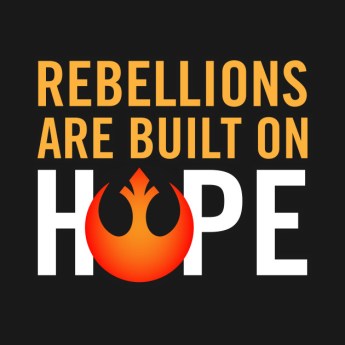
This kind of hope looks like the suicide mission in Star Wars to steal weapon plans so hopefully someone will pick up a transmission and maybe, just maybe, use them to save the galaxy. It’s not a hope that says not to worry about the flag of evil flying overhead because “It’s not a problem if you don’t look up.” It’s a faith in some possibility of a brighter day purely because “Rebellions are built on hope.” It’s a faith that answers, “Do you think anyone’s listening?” with, “I do. Someone’s out there.”

This kind of hope looks like “All our hopes now lie with two little hobbits, somewhere in the wilderness.” It looks like a final suicide march into enemy territory with, “certainty of death, small chance of success? What are we waiting for?!” It’s the kind of hope that sees the mission through with no rations for the return journey, relying blindly on others to carry things through to the end of the war.

This hope is powerful. It puts fire in your veins and helps your trials seem like small momentary afflictions. It’s a hope that says without any real reason to believe it, “in the end, this Shadow was only a small and passing thing.”

But the wonderful, beautiful, redeeming quality about this hope is that it feels imperfect. Incomplete. Unreliable. It just about fills us up, but leaves us craving more. It points us to a real hope. A solid one. One that is robust and whole, unchangeable and steadier than the rising sun.

It points us to our God.

The pagan hope in these stories leaves us itching for something half as good, and in the end points us to a hope far beyond all we could ever ask or imagine (Eph 3:20). When we read in stories how a fictional hope looks in everyday life, how “it is the small everyday deeds of ordinary folk that keep the darkness at bay,” we learn just a small fraction of what our real hope looks like in action.

These stories haven’t taught me that Obi-Wan Kenobi is my only hope. They’ve pointed me to the truth that without my hope in Christ, I should be pitied above all men. They haven’t convinced me that repeating “I am one with the Force and the Force is with me” is enough motivation to pass through a hail of bullets to complete the mission. They’ve taught me that on the rock of our confession of Christ as Lord, God has built his Church and nothing will prevail against it. Those stories haven’t moved me to stagger across a volcanic wasteland to do my part to destroy evil, even if no one ever knows what I’ve done or if it makes no difference in the end. They’ve convinced me, with all of my heart, that my real hope is worth sharing, toiling over, even giving my life—even if there are consequences, even if no one remembers my name, even if the mission isn’t completed for me to see in my lifetime. Pagan hope reveals to me the complete sufficiency of my hope in God that will not be disappointed and will not put me to shame.

So in my moments of everyday desperation, frustration, loss of hope—when I may not have hit rock bottom but I am only one step away, at apathetic inaction—I know now. People in these stories were holding on to something. But what are we holding on to?

Hope.

We hope in a savior who bears our burdens. We hope in a redeemer who lives. We hope in a God who lifts our faces, who turns our mourning into laughter. We hope in a God who invites us to boldly come before his throne. He was and is and is to come. He rescues us from our brokenness and slavery to our disobedience. He came to earth to live as one of us, to take on his own suicide mission to pay the price of our abundant life with his death.

That, my friends, is the hope we have. It can carry us from the smallest inconveniences through the darkest days of our lives. It’s a hope that propels us out to make disciples as we were discipled, to leave no place or people untouched on our march of hope. It is our sacred hope, and it comes with an unwavering, sweet promise: “I am with you. Always.”


Post Script:

Yes. I did write this after a Star Wars marathon. Deal with it. 😉 Am I slightly ashamed of how many of those quotes and references I knew by heart? Not remotely. I also wrote this on notebook paper, the old fashioned way, because I’ve had no power for the last 4 days and all my electronics besides my flashlight were dead. I even squished a couple of ants, that have become my thorn in the flesh, as they skittered across my pages. But from these super annoying inconveniences to the sobering reality of the many truly hopeless refugees around me daily, this hope I wrote about has been getting its exercise, flexing its muscles. And I can assure you that it is up to the job.

90e6804b-d2d2-4ef5-bbac-31ca27852eb2.jpgdac6b78ca18b7bb79ba8b4094009dc8f.jpg

Ezekiel: Scandalous Shame or Answering Hope?

Ezekiel is no joke. It can be a difficult book to read and certainly is difficult to understand. It often gets skipped over in Bible studies and sermons, and there are quite a few reasons for that. The book is arguably the most graphic in the Bible in terms of sexual and violent content. As literature in the apocalyptic genre, it measures high on the bizarre-o-meter with symbols, prophecy, and motifs that have no tether in our modern experience.

I always forget how graphic the book is. I don’t know Hebrew, but I get the feeling our translations of “member” for penis and “issue” for semen and “bosom” for nipples and “whoring” for sex are sanitized—words the prophet meant to be raw and irritating to us we gloss over with a euphemism. So why did he use them? What was the point? Certainly sexuality has a good and holy place in the lives of believers, but if that was Ezekiel’s point we’d have another Song of Songs instead of the graphic descriptions of lust, an affair, and acts of prostitution that Ezekiel writes.

To say nothing of the graphic depictions of violence including evisceration, rape, and rivers of blood, the sexuality in Ezekiel chapters 16 and 23 goes far beyond acceptable dinner conversation. But the prophet might not have known much about table manners. He was the one, after all, who ate food cooked over a poop fire for more than a year. I find it most likely Ezekiel is avoided in polite church conversation for this reason—he spoke about and did shameful things that make our skin crawl, make us want to take a bath. The shock of his writings often provokes physical responses like sweating, blushing, racing heart, tears, or shaking. We avoid the book because it’s uncomfortable. It makes us cringe.

But that’s the point of the book. One of its themes is shame, and not just any shame, the particular shame we feel when exposed at our dirtiest, most disgusting moments of sin. It’s the quality of shame we would feel if our deepest and darkest sins were found out. Ezekiel wrote and acted with shock to wake God’s people up to their sin, to convict them, and to call them out of it.

Have you ever asked yourself why the Old Testament so often uses sex and adultery as a picture for sin and falling away from God? Why that metaphor, and why so often? What does it have to teach us? Maybe we should ask why we don’t describe our sin that way today. Why is it more common to hear “food, work, busyness, etc. is becoming an idol in my life” than “I’m cheating on God with my binge eating” or ‘I’m having an affair with my schedule”? Granted, those don’t roll off the tongue as well, but why do we describe our sin differently than God does?

We often describe things as idols in our lives without any real reference to what idolatry meant to the Israelite people, or to real idol worship today. We misinterpret and overuse the idea of idolatry, which was exchanging God for another and totally betraying him. To the Israelites, idolatry was leaving one covenant and seeking another, totally depending on another god to provide for needs God had already promised to provide. We sanitize that word, idolatry, make it metaphorical, and use it to refer to the way we let the score of the sports game control our emotions, or our overeating, or the fact that we find too much security in our bank account. We call it idolatry because we don’t have firsthand experience with idols. We don’t connect our cutesy, pre-packaged words for sin with slaughtering our children in total devotion to idols like Ezekiel talks about.

Through the Lord’s inspiration, Ezekiel knew that perverted sexual appetite was a much better analogy for our sin habits we won’t kick. I believe we leave out the topic of sex from or conversations far too much anyway, but I also think Ezekiel’s graphic depiction of nymphomania and lust-crazed infidelity is actually a better picture of what we so quaintly call idolatry. Do you worship that football game you watch on Sundays? Or would it be more accurate to say you lust over it, fantasize about it, spend all your spare moments imagining how it might play out? Do you sacrifice your children for your gluttony, or do you fantasize about that meal or dessert you want to eat, count the time until you can consume it, imagine what it will taste like, dwell on it? Is your bank account an idol, or is it the secretive little thought that comes to you in spare moments to soothe you or make you discontented? Is idol worship more your pace of sin habits, or is it lust—wild-eyed, insatiable, ever-present sinfulness, an appetite that consumes and controls you at the expense of whatever else deserves your attention more?

We all know what lust feels like, a burning thought or desire you can’t quite put away, that leaves you feeling dirty but aroused, alive. With lust, we mentally throw caution to the wind because it’s hidden, and no amount of conversation or probing lets it out unless we allow it. Are your sin habits more like that? I know mine are. So pick your poison. Idolatry, or lust? Idolatry replaces God in an act of finality and betrayal. An idolater has at least made up his mind. Someone consumed by lust though, thinks she can have the goodness she desires as well as the goodness she already has. If your sin is better described by lust, you want to fill your appetite with other things the world has to offer in secret, but still enjoy your ‘righteous fidelity’ to God. Sounds like a pretty good description of me.

But Ezekiel doesn’t stop there, at calling out our sin and shaming us for it. He wrote to Israelites who were already in exile, already experiencing the punishment for their sin and slowly learning to reform their ways. Ezekiel gives hope and promise to answer the shame. The gospel is so beautifully present in Ezekiel, and we can see through the bars in the narrative to God’s enormous care for the lost nations of the world. God didn’t just care about Ezekiel and the Israelites. He led the prophet to call out the sin of the surrounding nations, but also to weep and lament for them. He called them to repent, just like he has called us as believers to himself. There are whole chapters in the middle of Ezekiel remembering the good qualities of the nations, and praising the unique gifts and abilities the Lord gave them in his mercy. The laments are heartbreaking because they describe the self-destructive sin of these nations and the inevitable consequences of their unrighteousness that they now must face.

After fully expounding on the shame of a lustful people who turn away from God and fill their appetites elsewhere, Ezekiel mentions the idea one more time: “describe to the house of Israel the temple, that they may be ashamed of their iniquities… and if they are ashamed of all that they have done, make known to them the designs of the temple…” What follows is a blueprint for the temple in Jerusalem in surprising detail. What is even more surprising is that this temple didn’t exist. Never has been built and most likely never will be. Ezekiel closes his book with chapters about a non-existent temple—what might have seemed a hollow promise to the exiled people, away from their homeland with no place to properly worship God.

Why would God shame his people with descriptions of a perfect temple they would never see, even after they returned from exile? This temple description would have been the reason people wept at the end of Ezra 3 when the new temple was finished. It was nothing like Ezekiel’s description. God meant for the people to be ashamed of their sin. He meant them to know fully and finally that they could never be perfect, never build a temple and carry out its practices as a perfect, pure, holy people whose hearts were fully devoted to God.

Hearing Ezekiel’s words in exile they must have experienced the sobering proof daily that they could not escape their own sin. As a consequence to their sin they were scattered among the nations. Their language, culture, faith, and even national and genetic identity as Israelites were precariously close to annihilation. As a people, they could be lost forever, blended in among other exiles in a foreign kingdom. They had fallen far short of the perfection of Ezekiel’s temple. It would have seemed unobtainable. And it would have brought them great shame.

But the theme Ezekiel had introduced in snapshots earlier in the book—the theme of a new covenant of God’s mercy and full and final restoration as a people—is an answering hope here fully developed in the context of the temple description. Apocalyptic literature like Ezekiel is meant to alert people to the cosmic realities of sin and its consequences, but also to bring hope to a people devoted to God. The temple he describes isn’t just an object of shame, it is also a symbol of hope. Ezekiel describes a prince who rules justly and leads his people in honoring God. He describes a nation at home in their land, righteous in their ways and prospering in their obedience. Ezekiel describes a new and restored Israel that gathers in its reborn capital city to worship the Lord in spirit and in truth. Perhaps the woman at the well asked Jesus about this very passage.

What Ezekiel describes as a sustaining hope to those repentant of their lustful sin is a restored nation: a pure and rescued people whose language, celebrations, and culture flourish. After fully recognizing the extent of their sin and wickedness, God tells them that one day his presence would be among them again and a perfect reality beyond their wildest imaginings would come true.

Jesus heralded this coming kingdom reality, but it is John’s description of the heavenly temple in Revelation that matches up precisely with Ezekiel’s vision. Ezekiel describes twelve gates for the twelve tribes, and John describes the same twelve also representing the twelve apostles. Both describe a river flowing from the temple, healing the land. Ezekiel promises a day when the Israelites who truly follow the Lord will be with him in his perfect city, and he winks at a coming reality the rest of the world couldn’t even begin to imagine at the time of his writing. He mentions a place for sojourners among the people of Israel, foreigners who are to be treated as natural-born citizens and given a share in the inheritance of the land and the perfect city and temple. He mentions us. We, too, are God-followers invited into the kingdom through God’s gracious mercy exhibited in Jesus. Just as Ezekiel described God’s presence coming down to earth once more and filing the temple, Jesus came down to earth and lived and walked with us in our imperfection, inviting us to share in the hope of a world restored from the ravages of sin.

This harsh prophetic book to exiled people opens with terrifying images of God roaming the earth in giant wheels. This same God spoke through a prophet to convict his present and future people of their shameful, disgusting sins, but he ends his message to the prophet and his audience with a perfect picture of a city and a temple where his presence dwells. The Lord who roamed the earth could be found even by a broken people far away from his temple, but he also showed them that he would soon choose to heal and perfect them, and live among them. The book closes not with God roaming above a broken earth, but with the new name of his perfect city to come, “The Lord is There.”