Tag: John 8

Mountain Snapshots pt 2

I wish I could bring you all with me when I go to the mountains, so you could see what I see and hear what I hear. But this time someone joined our group with a photographer’s eye and a camera to channel it. I’ll throw in some of his pictures below, but I wanted to give you some “mental snapshots” to go with them—thoughts and moments I’d always want to remember if I never saw this place or these people again. 


Sundays on these trips are different days. They brim with activity like every other day, but they’re unpredictable and often lead to unexpected adventures. Every “teaching” day I wear a more comfortable dress and headwrap, balancing cultural respect with functionality. But on Sundays I break out the Sudanese cultural dress, a toub. Meant to be worn over a full set of clothing, this long piece of fabric wraps multiple times around the body to cover legs, torso, arms, and hair in one unbroken block of color or vibrant pattern. I don’t have to teach or lead on Sundays, so my decreased maneuverability and comfort in the sometimes 7-layer getup is an acceptable sacrifice to make for all the sweet smiles from strangers who can see my clothes, hear my Arabic, learn my local name, and immediately understand I value them and their culture. 

This Sunday I don an all-black under-layer of leggings and a long-sleeved leotard, so nothing will bunch or twist under the layers of  toub wrappings. Then I choose the tie-dye purple and green toub that’s more gauzy and breezy than some—a gift from a friend used to wear it herself in hotter desert conditions than this. When everyone is ready for church we cut across a couple fields, tramping on the footpath I could never have picked out for myself while hiking my layers up so I don’t drag half a field of dried grass and stickers into church with me. We arrive and worship with our brothers and sisters through a beautiful service in a simple building decorated with fresh-picked local flowers hanging from the roof supports. A few holes and pockmarks in the walls from the last war’s aerial bombardment makes the building an even more beautiful testament to God’s protection. 

As we mingle in the yard after church the typical jokes follow about my positive marriage prospects if I keep wearing a toub, and theatrical surprise played for laughs at my Arabic comprehension when someone suggests a son or a nephew who might be about my age. Laughing, I hold the pumpkin our teammate was given as thanks for sharing the sermon today, and clumsily try to balance it one-handed on my head to demonstrate the poor excuse I’d be for a working Sudanese wife. As we walk back home I unwrap one torso-encumbering layer of the toub and re-wrap it to throw it over my shoulder in a less formal style women wear when they have work to do. I’ll wear it that way for the rest of the day for greater ease of movement. After lunch, a friend calls out “hey Kandaka!” as I pass by. He’s teasingly comparing me and the toub over my shoulder to the iconic 2019 Sudanese Revolution picture of a woman called Kandaka. She herself was named that after the long Sudanese historical tradition of female leaders and cultural nurturers who moved and shaped a people with their stories. You’ve likely read about a Kandaka (or Candace) in Acts 8. A crooked grin immediately splits my face at the flattering comparison, and that I caught the deep cultural reference. 

Not long after a relaxed Sunday lunch, we’re given a few minutes’ warning before a trek to go see a building site for a hoped- and prayed-for new Bible college. Unsure of how long the trip will take, I wad up my body and my layers in the half-seat above the gear shift in a truck older than me, sandwiched between the driver and my teammate for what turned out to be a three hour excursion. The bed of the truck is a clown-car of people, and two motorcycles flank us carrying those who couldn’t cram into the truck bed as we drive through gardens and dry river beds up to the crown of a mountain. We clamber around on the mountaintop for a while and pray over the site before we descend to explore the flash flood river bed and the new springs that opened up last rainy season. 

It was with pride that I managed almost as well as a Sudanese woman would in her own dress, and only caught my layers once on some fallen acacia thorns. In the dry riverbed valley below the brow of the hill, we see a baobab trunk that was swept down in last season’s flood. I still haven’t gotten over my giddy excitement of seeing these massive, distinctive-looking trees for the first time in my life in this area, so I rush down to feel its smooth, cool bark and branches I could never reach in standing trees. The youngest guys clamber up the side of the massive fallen trunk, and I know instantly I can’t miss this opportunity. With a moment to assess the physics involved, I kick off my flip flops and flex my toes in the sandy pea gravel underneath my feet. I hike up my layers and to accompanying shouts of “Go slow!” and “Don’t let the white woman fall!” I hop up the side of the ancient tree, using gnarled knots in the bark for hand and foot holds, with my skirts gathered in one hand. Everyone nearby swarms back up the tree and poses for a picture with the white girl in the local dress who miraculously avoided face-planting.

Photo credit: Johnny Rainey
Photo credit: author

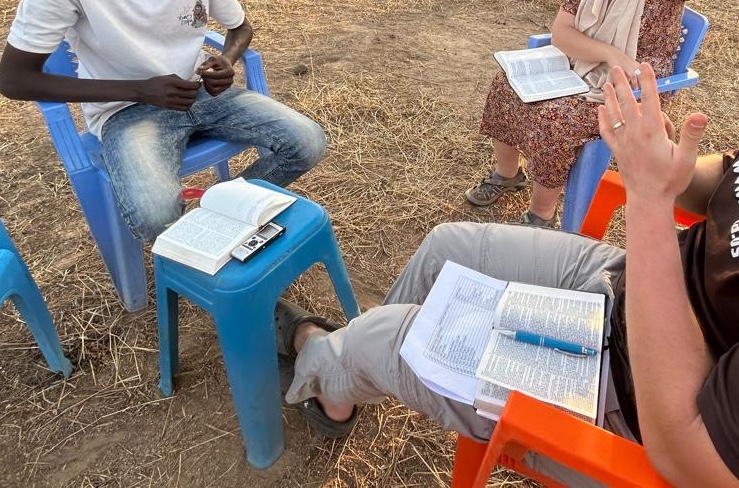
Toward the end of the week, I sat again under the same patchy shade of the same scraggly tree with the group of two young men. One has faithfully shown up to work every time we’ve visited. He’s my youngest brother’s age, and he knows me by my Arabic name that means “big sister.” This time we’re listening to the story of the woman caught in adultery from John 8 through translation from their language to Arabic. Every detail is accurate, and spit out in quick succession. Another deep story about how Jesus interacted with women who were publicly shamed, rattled off like a speed recitation. 

I take a beat to compose my thoughts and decide where to start to both compliment their good work and encourage them to go deeper and tell the story with more faithfulness to all those layers. But I didn’t have to worry. Perhaps more comfortable after we talked through some taboos earlier, my “little brother” blurts out, “where was the man?” A slow smile grows on my face as he continues. “If she was caught IN adultery, there must have been a man. Why didn’t the religious leaders bring him in too?” He has some theories that he rattles off, and I offer some more. But we dig into the story so he can see the way the religious leaders brought the woman there as bait for a trap for Jesus, to try to get him to say something against Moses and the Old Testament law. 

But I go back to some of the details in the story that explain some things between the lines. Miraculously God gives me the Arabic I need to communicate the nuance of this story. But I still don’t have the vocabulary to communicate the complex web of shame in this story that translates directly into these two young men’s culture. I explain that the story begins at sunrise, and how it was possible the woman was caught and brought in some state of undress when she was paraded out in front of everyone there at the temple to worship. I readjust the part of my headscarf hanging down over my torso, matching the unconscious expression of any local woman who feels exposed emotionally or socially. I hope my actions and gestures fill in for some of the nuanced vocabulary I’m missing, but before I know it, I’m up on my feet to explain the story spatially. 

When the religious leaders brought her into the temple, they treated her like she was only an object for their trap for Jesus. To answer the original question, they’re obviously thinking about incriminating Jesus more than incriminating the man she was caught with. But in the process, they make her the object of everyone’s attention. I stand in the middle of the circle, pulling my headscarf to cover more of my body. But then they ask Jesus, and not only does he take a long time to answer, he bends down and begins mysteriously writing in the dirt. I grab the shoulders of my American teammate, to use him as a stand-in for Jesus. Jesus could have immediately given them a wise answer, but he delayed. I step out of the circle and stand behind my teammate, with him between me and the young men. Now, everyone at the temple was looking at him and waiting for an answer. He was covering this woman and her shame, even though she had sinned. And not only that, he took some of the shame from her. When he didn’t answer, everyone looked at him and wondered if he could give a wise answer or if the religious leaders would humiliate him.

We continued telling the story with me walking through its paces, showing that Jesus chose to forgive this woman’s sin instead of condemn it, and to cover her shame instead of expose it. At the end, the young men had huge grins on their faces because they saw how Jesus has not fallen in line with heavy cultural shame directed toward women, but turned it on its head in order to protect them. I was glowing inside at the chance to be their big sister and tell them things other women aren’t socially allowed to. I was honored and humbled to help disciple them through the cultural expectations they face, so they can break the mold and be better brothers and fathers and husbands one day. 

Photo credit: Johnny Rainey
Photo credit: author

The Accuser and The Advocate

“Give yourself some grace!”

“Be kind to yourself!”

“Have more realistic expectations—be gentler on yourself.”

“Cut yourself some slack!”

“Stop being so judgmental of yourself.”

If I’m honest, those phrases make me cringe. They feel like hollow platitudes someone says to make you feel better when you’ve failed. They’re a consolation prize that says, “You messed up, but you can’t fix it. So just try to feel better about yourself since you can’t change anything now.”

Maybe those thoughts are unique to me, and maybe I’m harsher on myself than most people are, but from what I’ve gathered, lots of us deal with our own inner-critic. It’s the voice in our head that tells us we aren’t good enough, that we can’t learn from our mistakes, that we’re deeply broken enough it makes us unfit or unworthy or unwelcome.

From a secular perspective, we’d call this problem low self-esteem. We recognize it can be crippling, so we feed ourselves feel-better messages about our worth as a human and our general goodness at heart. “Girl, wash your face.” “You are a QUEEN.” “You deserve to be happy.” “You are your own worst critic!”

From a scriptural perspective, we just call it plain sin. Of course we’re broken; we’re sinners, even if we’ve been redeemed. We don’t deserve grace. Our sin deserves to be called out and punished. And until we’ve been sanctified and glorified in heaven, we can reliably count on our own sin to cause us to fail again and again.

But that’s not the WHOLE story of Scripture. Of course, we have inherent worth and value because we’ve been made in the image of God. And of course Jesus conferred value on our lives when he gave his to save ours. But the Bible teaches much more holistically that even though all the above things about sin are true, if we see our sin and failures as an insuperable barrier in our relationship with God or to spiritual growth, we give too much credit. Or, more to the point, we credit Satan with the win if we think God sees our sin first when he looks at us.


Recently trauma has loomed large in my own life. The stress of pandemic and national lockdown has uncovered buried traumas for many local friends and acquaintances, especially for refugees. Several people I’m close to—local, expat, and international friends—are working through their own traumas. And some of my own past trauma has been shaken loose by an accumulation of stressors and triggering reminders. Heck, the whole world is struggling right now. If you’re reading this, you’ve probably had more or different stress this year than you’ve had in a long time. It’s not unlikely that you’re struggling to get a handle on some trauma of your own.

For many of us, these traumas and their recent resurfacing have tipped us farther away from a place of mental health. Especially where abuse or sexual trauma were concerned, we tend to lean into self-blame, harsh judgment, or setting high standards for ourselves that are impossible to meet. Our inner-critic plays on loud-speaker in our minds, sometimes drowning out even rational defenses. Maybe since our brain can’t cope with what happened, we try to blame ourselves when we experience sin so evil and destructive it seems to defy explanation. We’re just trying to make sense of the broken world around us, so we ask ourselves, “DID I do something to cause this sin against me?” Or, even worse, we skip the question and jump straight to, “I should have known better.”

That assumption, and all of its brothers, are destructive: I should have planned better; why didn’t I see this coming; this is all my fault; I caused this; I should have listened; I am too naïve; why am I still so immature; I wasn’t praying enough; I should have worked harder; if only I hadn’t…; if I had just done…

The TRUTH of the matter is the Bible doesn’t leave room for ANY of these accusations. Sure, we should let the Holy Spirit convict us of our sin. But a proper response to that is repentance, forgiveness, and praise for our redemption. Nowhere does scripture teach us that self-judgment or self-accusation for our sin is productive or God-honoring. In fact, 2 Corinthians 7:10 says, “Godly sorrow brings repentance that leads to salvation and leaves no regret, but worldly sorrow brings death.” You know what that whole list of accusations brings? Regret. And a morbid sorrow. Blaming ourselves in these ways—either for sins we committed or for sins committed against us—fills us with a living death instead of the abundant life the Lord intends for us.


Scripture is VERY clear that, if we follow God as our Lord, we have an unquestionable standing before him, and no accusations against us hold up. No matter how broken or dirty or at-fault we feel, we have a place in the heavenly throne room. We’re invited to approach God’s throne boldly.

In Zephaniah, the Lord gives the prophet a message to tell his people how they will suffer. He foretells judgment and devastation that will be a consequence of the people’s own sin but also of the sins of their leaders and ancestors. In the midst of describing justice and punishment that is surely due, among the threats and warnings of suffering to come, the Lord comforts his people with some of the tenderest words in the whole Bible.

“The Lord your God is with you, the Mighty Warrior who saves. He will take great delight in you; in his love he will no longer rebuke you, but will rejoice over you with singing.”

No matter how broken or full of blame we feel, the Lord is kind to see and treat us in these ways if we are his. He is our mighty protector. He saves us from disaster. He is delighted with us. He loves us deeply. He is so full of joy when he considers us that he bursts into song! Eternal God, ever-present in the always-now, sat with his people the Israelites BOTH in their time of suffering and in their time of redemption. He saw them in the depths of trauma they felt from the consequences of their own sin AND in trauma they felt from others’ sin against them, and he consoled them. We aren’t the Israelites, but we are God’s people if we follow him as Lord. And since his character never changes, we know his care for his loved ones remains the same, whether it is directed at us or at the Israelites.

He told them that despite their sin, he saw them as precious. As worth protecting. As worth saving. As delightful. As worthy of love. As a muse to inspire singing. He saw them this way before their trauma, after their trauma, and in their trauma. When we can see nothing good in ourselves and focus only on judgment we think we deserve, God sees these good things in us instead of the blame we heap on ourselves. But perhaps we aren’t the only one working to shovel to bury ourselves in accusations. Maybe it’s more sinister than that.

In Zechariah 3, another prophet describes the throne room of God himself, as seen in a vision. The high priest Joshua stands before the Lord, dressed in filthy clothes that make him unclean and unfit to be in the Lord’s presence. But he does not stand alone. To his right stands Satan, the Accuser. And the Angel of the Lord is also there (some understand him to be Jesus). Satan accuses the man, but the Lord will hear none of it. He rebukes the Devil and silences him. Before everyone present, the Lord claims Joshua as his own. He rebukes Satan and says he has chosen Joshua, and saved him from destruction. Then the Lord takes away the man’s clothes that display his sin and mark he does not belong. The Lord gives him new, clean clothes to give him a sense of dignity and belonging—things he did not deserve, but that the Lord gave graciously.

Perhaps Satan had grounds to accuse the man in Zechariah’s vision, but the Lord would hear none of it. Instead, God listened to the angel and cleansed and gave the man a place in the throne room despite his sin. In case we are tempted to dismiss these ideas from Zechariah and Zephaniah as only an Old Testament theme that doesn’t follow to the New, listen to John’s words.

The name “Satan” itself means accuser. This is a fitting depiction of Satan’s actions in the Old Testament. The first chapter of Job presents a vivid picture of The Accuser appearing before the Lord to report, as if this were his habit. Zechariah also describes Satan in the Lord’s throne room, waiting by to accuse Joshua. These and other passages build a picture of Satan as a character in a courtroom, the formal accuser.  

But when Jesus comes, he promises another character to stand beside us in the courtroom. As John recounts Jesus’ encouraging words to the disciples in the upper room just before his death, he tells us much about the Holy Spirit and the role he will play after Jesus’ resurrection. In John 14:16 Jesus says, “And I will ask the Father, and he will give you another advocate to be with you forever—the Spirit of Truth.” The word Jesus uses to describe the Holy Spirit there is a legal one. It refers to legal counsel, but also to someone in the courtroom who would formally stand up against the accuser and defend or advocate for the person on trial. Even here, before his death and the means of our justification, Jesus promises that the Spirit will stand with us and advocate for us before the Lord, against The Accuser.

Jesus models this again clearly in the story of the woman caught in adultery (John 8:2-11). She is dragged into the temple and humiliated, put on display in front of all the Jews and religious leaders gathered there. She is singled out alone—the man she must have been caught with was not brought along and accused in the same way. As the religious leaders repeatedly ask Jesus to condemn the woman for her sin, he repeatedly ignores or refuses their questions. In perhaps what was embarrassment or indignation on the woman’s behalf, Jesus awkwardly doodles in the dirt while her accusers wait. Finally Jesus tells them if there is anyone sinless among them, throw the first stone and begin to execute her punishment.

As everyone slowly goes on their way, the woman is left with the only sinless one among the crowd, at her feet, playing in the dirt. The only one with the right to condemn and punish her stands up not to take her life, but to address her with dignity, as a human. He protected her from fatal judgment. He advocated for her and stood his ground even when his own reputation and life were at stake because the religious leaders were trying to find fault and accuse him. “Where have they all gone?” he asks. “Has no one condemned you? Then neither do I.” He frees her to leave that place and her sin behind, to live in the freedom of repentance and forgiveness. Jesus had every right to accuse her, but instead chose to offer his wordless, calming presence as an embodiment of grace. He stood by her, included in the halo of her shame, when all looked to her to condemn and judge. And instead of accusing and serving fatal justice, Jesus freed her from the dragging weight of her sin and accusations.


So what do we learn from all of these passages about accusation—merited or unmerited? Simply this: God desires grace and forgiveness for us. He does not hunger to bury us under the weight of vindictive accusation. The running dialogue of crippling judgment in our heads is not from him if it leads to regret or a deadly weight or anything other than joyful repentance. So if the inner-critic, the voice in our heads, judges us more harshly than Jesus does, we hear nothing but the voice of The Accuser himself. And the only appropriate response is what Jesus said when Peter rebuked him: “Get behind me, Satan. You are a stumbling block to me… ”

So friends, believers, whether you’re dealing with an overly judgmental trauma brain, or wounded thought processes that bite at you from stress, or unhealthy mental patterns that come from anxiety and depression, or just your average level of self-criticism, dig into these scriptures for yourselves. DON’T give yourself some grace, because it’s not yours to give. But remember the grace the Lord offers you, even knowing full-well the depths of your sin or your innocence in the situation you’re concerned about. He is a just God and he doesn’t blindly dismiss the things you judge yourself for. He is a gracious and loving God, full of compassionate mercy. He dismisses the accusations leveled against you because your sin has no hold on you—it has already been paid for and punished through Jesus’ work on the cross. Nothing you or Satan accuse you of should weigh you down, because Jesus stands before you and the Spirit advocates for you in the great cosmic courtroom. Listen for the voice of the Advocate through your prayers, rather than the jarring voice of The Accuser. God has already silenced him and his accusations, so you have privilege to ignore him as well.