Category: Bible and Life

TGIF

Friday morning between 4 and 5 I woke up to a break-in happening right outside my bedroom window. Not much was taken. He didn’t get into the part of the house where I was. No one was hurt. Teammates were willing to come over in the middle of the night to help me feel safe and sort things out.

Later that morning, I had my first language exam. I expected a progress report that would tell us what areas I needed to strengthen and how far along I was. But instead I tested out of full-time language, with less than 7 months of cumulative classes. Our benchmark to test out is Advanced low. I was scored two levels higher, at Advanced high, in all categories except for the two that were Superior—the highest level possible. Like, native speaker fluency. In Arabic. A couple days later and I’m still in shock.

And if anything describes the emotional roller coaster this last month has been, those two events do. Friday was a bouquet of adrenaline, too many emotions for one tiny body, numbness, confusion, and exhaustion. I didn’t cry at the break-in, like a normal person would. Oh, no. I cried after my team leader told me what my language score was. Like a crazy person. And they weren’t happy tears. I have a complex about being a know-it-all, a desire to have genuine empathy and encouragement for people struggling to learn, and I hate even the implication that something I’m good at makes people feel uncomfortable.

I tested out on the same day two other ladies on my team did, and they have worked their tails off to get where they are, and sacrificed so much. I felt ashamed: ashamed that I hadn’t had to work as hard or as long. And I still don’t entirely believe the test results, even though a stranger and an acquaintance administered the test. I know how much I still don’t know, and the score makes no sense to me. So from some lethal combination of shame, adrenaline, exhaustion, and some twisted self-pity, I sat in my car and sobbed.

Don’t ask me how that makes logical sense. It doesn’t. It makes as much sense as any sin or brokenness the Enemy throws at us to attack our minds, because that’s exactly what was happening. In the aftermath of THEMOSTEXCITINGFRIDAYIVEEVERHAD, the Lord has been gracious to help calm my mind, to help me rest in him, and to give me clarity and assurance of his presence.

First of all, before I could even think straight, the Lord was already surrounding me with love, like a great big hug from the Body of Christ he’s put around me. So many members of my team gave me actual hugs, encouragement, exhortation, and genuine congratulations. My Sudanese friends literally danced for joy, helped me laugh, and told me they never doubted how the test would go. Friends and family sent messages to help me work through the shame and try to open my eyes to what a wonderful gift my test results were. Ugandan friends expressed so much sorrow at the break-in, physically grieving with me and helping me find words for the violation I felt. And ALL of these friends redirected my focus to the Lord who gives good gifts and gives them differently across all the members of his Church. It takes a village, folks. Africa has given such a richer meaning to proverb. But all I know is this single girl wouldn’t be in her right mind without her village.

MAN, am I blessed. God threw some foreshadowing into my day just for grins and giggles. During my test, one of the topics I had to talk about was my friends around the world. Even when I wasn’t paying attention to what was coming out of my mouth, the Lord was having me list people to be grateful for. He reminded me of how many kind, sacrificial, and loving friends I have—here in Uganda from so many different countries and cultures, in America from so many different states and contexts, and friends around the world who are in this same, roller-coaster expat missions life.

The Lord reminded me that HE is the one who has provided the people around me. And HE is the one who is stable when my life feels anything but. He is good when everything is changing around me, and it’s only the blessing of his love and goodness to me that carries me safely through the low times and the high times. I’ve been reading lately through the Kings. I’ve seen the same roller-coaster of faith in their lives. King David had so many ups and downs, but after every time he crashed and burned, in the middle of every blessing he received, he praised God. He constantly reminded himself of God’s presence and lived a more God-honoring life because he intentionally brought himself into God’s presence even when it was uncomfortable.

David was blessed above and beyond what he deserved, because God delights in showing grace and mercy. Solomon came along and was the wisest man the world has ever seen. God gave him discernment, the reverence of the world, riches beyond compare, and fame beyond imagining. But when Solomon turned his eyes from the Lord who gave him these gifts to the gifts themselves, he stumbled and fell. And the Lord took his kingdom and shattered it in consequence.

In church this morning our sermon was about the same thing. Peter walked on the water to Jesus, but when he shifted his focus from his savior to the problems he needed saving from, he began to sink.

Friends, it is SO. EASY. to fall away. You get distracted for one second from intentionally dwelling in God’s presence and you’ve forgotten to praise, forgotten who deserves your gratitude, forgotten that your savior is bigger than both the waves around you and the blessings he’s given you.

If anything, that’s what THEMOSTEXCITINGFRIDAYIVEEVERHAD has taught me. My loving heavenly Father had already prepared an answer for the burglary before it even happened. And my language score wasn’t by accident, isn’t something to wallow in or hide or feel ashamed of. It is simply a gift he gave to be used to further his kingdom. I cannot tell you how my excitement has grown as I’ve allowed myself to imagine actually becoming fluent. The opportunities to communicate, to share Bible stories, to disciple, to learn culture and build friendships in deeper and more meaningful ways are endless. This gift doesn’t need to be buried in a hole, but invested to bring great returns for my Master.

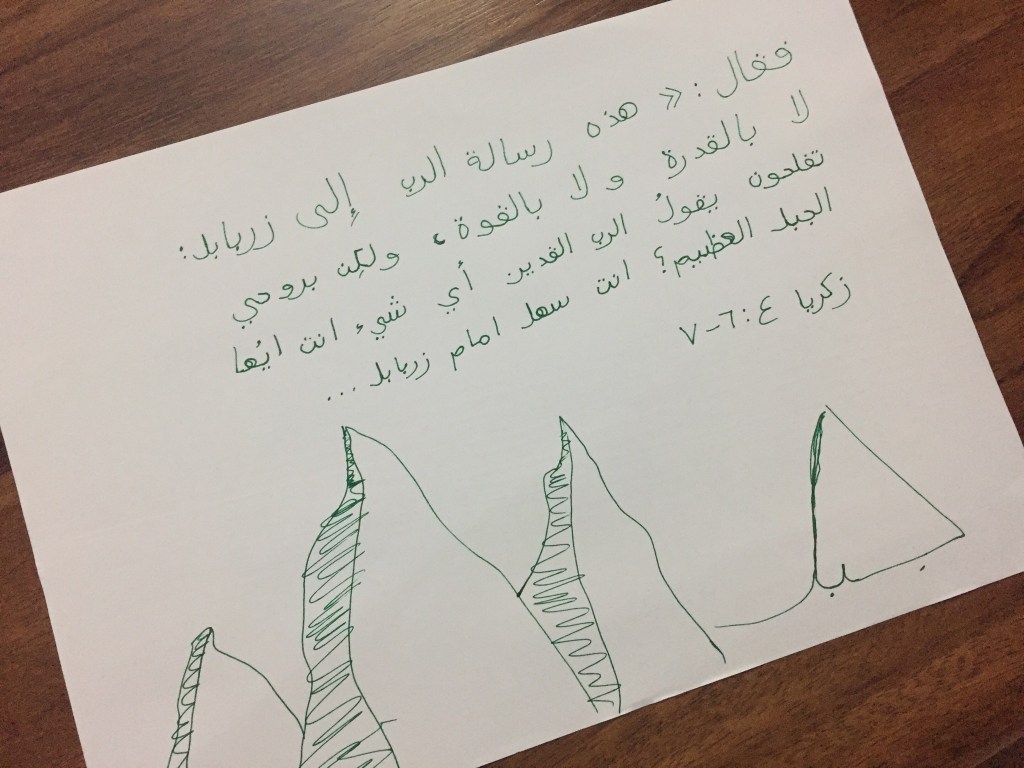
A long time ago I had some artwork on my computer desktop screen of the golden lampstand and olive trees Zechariah describes in chapter 4 of his book. After the angel shows him this vision, he asks what it means. The angel answers him with the Lord’s message that the Temple of God’s presence will be rebuilt. And it will be rebuilt not by might or by power, not by skill or by endurance, not by determination or ability, but by God’s Spirit. You can almost hear the angel laughing as he delivers the message. Who are you, mountain, to stand in the way of the Lord’s work? You will be smoothed out into a plain. God’s work will be completed by HIS power, and anyone who has despised or despaired at the small things that have happened along the way, they will rejoice.

It’s that way with all of God’s work. No storm on the sea of Galilee, no Old Testament dynasty, no break-in in Arua, Uganda, no failed language exam, no road block of any kind can stand in the way of what the Lord wants to do. It’s our job to sit back, have faith, and rest in the power of the Lord’s Spirit. Don’t despair at the small things friends, don’t despise the obstacles that seem so big, and don’t get yourself bent out of shape at the good things you think you’ve done either. It’s all the Lord. He wins the battle every time, and we just get the blessing of being a part of it.

To remind myself of those very words, I made a little Scripture art for my wall:

Then he said to me, “This is the word of the Lord to Zerubbabel: Not by might, nor by power, but by my Spirit, says the Lord of Hosts. Who are you, O great mountain? Before Zerubbabel you shall become a plain.”
1F95CDE8-7DC7-4612-A7FC-60AC3914CD12.jpeg

Let me Come to the Rescue! (Or, the White Savior Complex)

IMG_5100.JPG

Most mornings I’m awoken by the sound of a bird tapping on the glass in my bedroom window. She usually sits outside a living room window, but if I’m not up early enough, she comes to find me outside my bedroom. If she knows I’m in a room she’ll sit for hours and tweet and tap on the window, waiting for me to pay attention to her.

When I first moved into this house I thought maybe she must have had a nest inside at one point. Or maybe she remembered something from her past that drove her inside. I couldn’t figure it out. Then one day I crumbled up some old bread and put it outside on her windowsill while she watched me from safe distance. She came right down as soon as the coast was clear and started munching happily.

Then I realized that someone who lived here before must have fed her. And now, instead of hunting for her own food, she would spend all of her waking hours ramming her head and beak into a window, waiting for food to be delivered, just sitting in the nearest tree and chirping if she couldn’t get anything to eat.


At first my little bird friend made me feel like some weird African version of a Disney princess. I talk to the geckos in my house, the frogs that try to get in have names, I hold negotiations with the spiders (if you don’t come any closer I’ll let you live and go on your merry way), and now a bird would happily spend her entire day sitting on my window sill and talking to me.

But as the days have worn on, I’ve started to feel sorry for her. Does she even remember how to get her own food? Is it hurting her to bang her head against the glass? What twisted instinct won’t let her go about her day like a normal bird?


Have you ever read the book, “When Helping Hurts”? If you haven’t, you need to find a copy. The book talks all about what some people call a White Savior Complex. It’s full of lots of hard truths that make us evaluate what we often see as our most selfless urges. It helps us recognize our pride and our twisted understandings of how to actually help people in different situations than us. It gives a clear picture of all the brokenness in our world since Adam and Eve first ate that fruit, and how often as white people, or Westerners, we are blind to some of that brokenness.


To illustrate that point, let me give you a quick quiz. Think about each situation and come up with the best course of action you could take in it.


  1. A church member is bitten by a snake. His foot swells up so badly he cannot walk and doesn’t seem to be healing. He can’t get to a clinic and can’t afford medicine that would cost less than a meal would cost you. What will you do or bring next time you see him?
  2. Your church has a children’s choir and they want to buy cheap matching shirts for the kids so they can take pride in helping to lead worship. They mention the need to you and ask if you can give less than $15 to cover the total cost.
  3. A neighbor you’ve never met comes to your door to explain about the children’s home she helps with. She asks if you’d be able to give a small donation?
  4. A recent storm took the roof off of an African church you attend weekly. The sheet metal they want to use to replace it costs just a little over what your monthly tithe would be. Or you also know of a church in the States you could connect them to that would pay for the roof and more without batting an eyelash.
  5. Because you receive an American salary instead of an African one, dropping as much as $5 in the offering plate more than doubles the offering for the whole church. How do you give an offering?
  6. In the capital city any traffic stop is crowded with street kids and mothers with babies begging at the car windows for food, money, anything. How do you interact with them?
  7. A woman from your neighborhood shows up at your door one night asking for help, and she really seems to be in a bad way. She knows you work at a local church and thinks you can help.
  8. A family shows up every month at your church’s food pantry. They live in their car and are caring for grandkids.


What were some of your answers? Did they involve money or material gifts? Easy, one-time solutions to the problems? Would you have ‘fixed’ every problem it was in your financial power to ‘fix?’ Did these situations make you squirm? Did you feel any guilt or shame?


First off, I want to say that I don’t have easy answers to any of the questions and difficulties this blog post is focusing on. There is no one-size-fits-all answer, and from what I’ve seen so far, the best answers are ones that come from deep prayer and learning wisdom from others who’ve been living and working through scenarios like these for years. I also want to say that all of these are real scenarios either I or close friends of mine have experienced. And believe me, they have made me squirm and feel some deep guilt. If these questions don’t make you uncomfortable, or if you don’t live close enough or expose yourself to needs like these often, I think Jesus would say you’re doing something wrong. He seemed to nearly always be within arms’ reach of the hurting, the poor, the sick, the broken-spirited.


Next, I think it’s very important to recognize that we should take our cues here from Jesus himself, not necessarily from books or popular cultural wisdom, or even political opinions. Having read the book, “When Helping Hurts,” I can tell you that it struck me as very much in line with what Scripture teaches and how Jesus interacts with the least of these in the Gospels. So, again, I would urge you to pick up a copy or find an audiobook version.


But now let’s get down to brass tacks. The book talks about the white savior complex, and I have seen it and participated in it more times than I care to admit. Something in us, admirable at its heart, sees hungry children and wants to feed them, sees out of work fathers and wants to help them provide for their family, sees mothers with no support and wants to help them get back on their feet. Those things aren’t wrong in themselves, but we often have a very twisted way of going about helping.


What “When Helping Hurts” talks about is that, being perhaps more materially blessed than our counterparts who need help, we want to give them material things to fix their problems: money, food, gifts to meet the immediate needs. There is CERTAINLY a time and place for this type of giving. Anyone who says otherwise hasn’t read their New Testament.


The problem comes, though, in how and why we give those gifts. When we have money to give away, medicine to fix an illness, donations to meet a need, what we often don’t recognize is that our gifts can sometimes make the receiver feel more helpless and incapable. And often with our response of material giving, we unintentionally communicate that material wealth can fix problems, and that because we have that material wealth to give, we are more whole or have fewer problems ourselves.


This is a Western, and often white, mindset. And it has some huge blind spots. Think about Jesus’ Sermon on the Mount for a second. He opens with describing what we think of as poor and broken people. The lowest of the low. The least of these. But if you look closer, that’s not actually who he describes.


In Matthew 5, Jesus talks about the poor in spirit, the people who mourn, the meek or low people, people who hunger and thirst for righteousness, the merciful, the pure in heart, the peacemakers, and the persecuted.


Can those people be materially poor? Sure! But the text actually says not one thing about that. It talks more about people who are broken in spirit, who are relationally and spiritually poor, not hungry or materially impoverished.


Those phrases, “relationally poor” and “spiritually poor” sound strange to us. They’re not categories we often use to measure wealth or brokenness. That is our white, western blind spot. Whether we would recognize and say it out loud or not, often on some level we see most brokenness as connected to material poverty, not poverty of the soul. And in so doing, we often miss our own poverty of the soul. Depression, isolation, loneliness, aimlessness, poor self-esteem—these are all the problems of people impoverished of the soul. It’s the westerner’s own patented brand of brokenness, and much of what we would call the materially poor world doesn’t struggle with it like we do. They have tight communities, close family, they often share resources and spend hours on hours of relational time together.


When we try to fix a snake bite by giving medicine, instead of teaching the budding medical worker in our church congregation what it means to visit and learn to care for their neighbor, we focus on material poverty instead of relational poverty.


When we throw money or material gifts at problems without stopping to consider their larger context and causes, we put a material band-aid on a broken soul problem. I don’t mean that we should roll down our windows and hand a tract to the street kid or only share the gospel with the woman who shows up at your door asking for help. James bluntly calls that faith without works and he says it’s useless to close the door and send them home wishing them well-fed and peaceful and warm. There is a time and place for material gifts.


But so often we mistake a need for spiritual and relational gifts for a need for material gifts. So often we give money or material things instead of giving time spent together grieving, or visiting, or listening, or an opportunity to help someone learn to provide for themselves, or to help a church grow in its faith by seeing they are capable of raising their own money for the project God has laid on their heart. We give away opportunities left and right to mentor people or walk with them through a problem when we just try to give them a Thanksgiving food basket and call it a day.


What’s worse, when we give that food basket and don’t spend time getting to know the family in need, we can easily think we’ve saved the day. We might think that because we walk away feeling good about ourselves for meeting a material need, or because we don’t see the relational and spiritual needs we didn’t spend the time to notice. Maybe what that family really needed was a friend, a neighbor, someone to connect them to a job. But we’ll never know that because we didn’t spend the time of day with the family to hear about any other brokenness besides material.


I’m white. In rural Africa especially I get mistaken for a dollar sign. While I may be poorer than some of you reading this, If I’m not careful, my small gift of less than two dollars can double the offering for a church service in a poorer section of the camps. And that can create problems I would never think about.

For example, when someone asked us to buy uniforms for the children’s choir, if I couldn’t have afforded the expense, I almost certainly could have connected them to a church happy to do it. But does that really help, in the long run? Maybe. But if the church asks for this, what else could we find the depths of our pockets to help with? Do they learn to give sacrificially? Or do they learn to depend on outside help? What happens when I’m not there? Have I helped at all? Yeah, I met a physical need, but did I deprive of an opportunity to learn a spiritual truth, to have the blessing and pride of watching your own children dancing and praising the Lord in uniforms you saved and prayed for the Lord to provide? When I leave a church to go ‘help’ another, will this church know how to run by itself, or will they continue habits, like depending on others, to run smoothly? That may be an exaggeration of what I would be capable of doing in a church, but all of those are pitfalls that have tripped up not just missionaries, but good-intentioned Christians all around the world who understand that God loves a cheerful giver, but don’t always think through how best to give of themselves.


White people here are usually here for one of three reasons: missionaries, aid workers, or businessmen. We come from affluent societies with truly heartfelt desires to help, but we can often be misguided. If we think we can come and dump knowledge of how to run a church, better hygiene, or better business practices, we may in the end help short-term with the money situation. But it’s the old proverb of ‘give a man a fish, and he eats for a day, but teach a man to fish and he eats for a lifetime.’ We can’t just throw money around and think we’re helping. We have to realize that we may come into economic brokenness, but our spiritual or social brokenness can be just as crippling. What do I know of hospitality? Of sharing my last scraps of food just to make someone feel welcome and like part of my family? Do I have a poverty of relationships in the way my neighbors may suffer from economic poverty? Is my tendency to make a business arrangement like a house lease with as little personal contact as possible to keep a distance or respect privacy?

My neighbors sit down to tea first to show kindness and goodwill before ever bringing up business. They’re happy to teach me to make tea like they do even if it means they have to choke down something unpalatable a few times. They immediately know the sadness it must be to live alone and isolated rather than valuing independence at the expense of relationships. I could funnel all the financial resources I could connect to into Africa and not even fix the problems in my own neighborhood. These problems come at root from neighbors who do not know they are cherished children of God. They come from broken senses of self and not knowing how to think of money in the long-term, or not having family that taught them how to plan financially.

But I come bearing my own problems of fierce independence at the expense of relationships. I come with a worldview completely alien to Jesus’ words, “Blessed are the poor in spirit, for theirs is the kingdom of heaven.“ Do you know what that really means? It means that if my African neighbors have a better grasp of spiritual poverty and understand their need for God and the community of believers better than I do, they truly have a better grasp of the Kingdom of Heaven. Because I don’t know what it means to be poor, to give a widow’s mite, to use the last flour and oil in my house to bake bread for a prophet, to give a thanksgiving offering to the church because I recognize the Lord’s blessing in my life. I have a LOT to learn from the people I live in and amongst.


So what does all of this have to do with the bird that spends her life in my windowsill pecking and asking for bread? Not much, just this: sometimes it’s easy to give out bread and think you’re being helpful or saving someone a little trouble. And sometimes you are. But we must be ever so careful that when we give out that bread, we aren’t thinking of ourselves more highly because of it. And we have to think through very, very carefully—are we meeting a need in a way that helps for a lifetime, or are we meeting a need in way that cripples in the long term and teaches dependency? Are we walking alongside someone for the long haul and giving dignity and empowerment, or are we putting a material bandaid on a much deeper need and patting ourselves on the back?

Thoughts Addressed to the Gecko on my Wall

It’s been 6 months. Six looooong months, of adjusting to heat and new diseases and inconsistent electricity. But it’s also been six short months, of learning a beautiful language, building relationships, making new friends, loving the sunshine and the rain and the growing things, and making a home. I could give you an introspective blog on what life has been like these last few months, on how I’ve grown in my faith and the ways that I’ve changed. But I’ll save that blog for another day. 😉


Instead, I’ll give you a fun bullet-point blog, on the interesting and funny things these last six months have held. Hopefully these bite-sized stories will help you share a little bit in my unique sense of humor, in the shocks and the fascination, and in the joy of experiencing new things.


A gecko lives in my room, and another in the bedroom across the hall. I talk to him now and again to thank him for eating the mosquitos that eat me. Maybe Africa has messed with my brain a bit too much. 😉 The first gecko I met, I named Moki. The gecko in my room got the name Loki. So, naturally, his brother across the hall got the name Thor. Every once-in-a-while these geckos get to catch some of my musings as I’ve adjusted to life in Africa. I like to think they’re becoming a bit wiser from the things they hear, but perhaps more likely, they’re just entertained by my foibles. These are some of the events they have borne witness to.


  • When I first got lice in Bulgaria, I noticed by the eerie sensation of a creature crawling on my hairline. At first the sensation here gave me shivers down my spine and sent me rushing to the nearest mirror to check. But I’ve since learned that here it just means I somehow picked up a harmless stray ant from my house and he couldn’t find the way back home. They’re not as difficult to kill as lice, though… I have gotten used to the sensation because this is as much my house as the ants’. They live in the kitchen, in the bathroom, and even cross my bed on their own mysterious errands.


  • My water heater reminds me of a curmudgeonly old man. He’s quite persnickety. Turn him on just before your shower, and you get only cold water. Turn him on all night before a morning shower, ice cold again. Three hours prior to a shower, still no heat in sight. The sweet spot is 1-2 hours. He heats up the water just fine, but the trick is catching enough for a shower without giving it time to cool down.


  • Uganda has two types of mangoes. The bigger ones can be up to 8” tall, and they’re ripe when they’re green and red. The other smaller ones are ripe when they’re yellow. Regardless, don’t stand under a mango tree in ripe season. The trees carry hundreds of them, and those suckers are likely to smack you square on the noggin.


  • I arrived here during the hot dry season. We could go days without electricity at the worst of it, and when we did have electricity, it often wasn’t on during the night to run fans for noise or to keep off mosquitos. I also couldn’t master keeping mosquitos outside the net over my bed. You can hear that infernal buzzing before you can see the little buggers, so it was a nightly occurrence to wake up to the sound, flip on a flashlight, and hunt down as many as five of them before I could go back to sleep.


  • When rainy season came, and with it nightly electricity, the sound of the blessed fan drowned out the mosquito buzz, so I would be confounded to wake up in the morning to bites on any part of my body outside my covers. I spent a few weeks researching ants, gnats, and midges, to see if I could figure out what else might be biting me, since I couldn’t hear the mosquitos anymore and I was so sure it wasn’t them. I did enjoy pretending I was a hobbit getting eaten by midges. “What do they eat when they can’t get hobbit?” Best to make light of an annoying situation.


  • Personal hygiene is different here. Water is scarce during dry season, so is electricity to heat the water, and lukewarm showers with any kind of water pressure are few and far between. I used to wash my hair daily in the States. But now… The large bottle of Suave rosemary mint shampoo I brought with me is still going strong over six months later.


  • Life is much more holistic here. It involves body, mind and soul in unified ways North Americans can’t easily wrap their head around. For example, in church we praise the Lord with our whole bodies. From toddlers to grandmas, everybody able dances at least a little with worship. Some songs have you clap hands with someone next to you. Some songs you shuffle your feet in time and kick up dust. Some songs you touch your head, eyes, ears, crouch down slow and dance back up. Praise isn’t just mental or spiritual—it’s physical. Gratitude is too. It’s not uncommon to give an offering of a chicken to the church instead of money in the offering plate.


  • It’s funny how easily I flick the ants off of my bed, by body, my food. I have jokes with the ladies I teach to bake for the coffee shop. We knead and roll out lots of dough, and for some reason that’s like catnip for the ants. It summons them from near and far. So we call them fil-fil, which means pepper in Arabic. They’re just another ingredient to give it that real African flavor, because sometimes you just can’t catch them all. Extra protein, right?


  • We get to have fun pets here. Aside from loving, dumb, drooly dogs that “guard” our homes, several of our families has baby iguanas for pets. Ugandans are TER-RI-FIED of them. But they’re adorable little dudes! My favorite is the one named Darth Vader. All his buddies like a nice resting cool cucumber color with flecks of orange and blue and red speckled in. But not him. That’s too mainstream. He goes for the exact coloration of a rotten banana peel. He has to let everybody know about his angst so they don’t confuse him with “those other Iguanas.” Their lack of faith disturbs him.


  • It might be surprising to you like it was to me, but there are lots of ethnic Indians here in Uganda. They came with the British and stayed on when the British left. Many of them run grocery stores, and because of their impeccable tastes, we are blessed with a bounty of spices to season and cook with. It’s literally my dream. I can get just about any spice I’m looking for if I know who to ask. In fact, one of the markets run by an Indian family here is called Dream Shoppers. The stuff dreams are made of, people. Cinnamon and ginger and cardamom for dayyyyyyys. Want garlic powder? Done. Cumin? We sell it by the kilo. Spices you’ve never heard of? Why not give them a try?


  • Taxis don’t really exist here. People walk for long distances, or ride on a lorry or a bus. But to get around town you can ride a boda boda. They’re motorcycles, they drive recklessly and always think they have right of way. They’ll usually get you where you’re going for less than 5 dollars (or as little as 30¢). On my walks I always get beeped at, sometimes yelled at, to see if I want a ride. “Miss, boda?” “We go?” It does feel kind of fun and adventurous sometimes to ride through town with your hair and giant earrings billowing behind you. Even more fun to surprise some of the drivers by deciding to ride side-saddle behind them like a graceful, poised African woman. Just hold on tight around those corners!


  • Everything grows here, especially during rainy season. We keep a plastic trash bucket on our back porch for food scraps, leftovers, discarded bits of stems or peels or seed that might attract ants if put in the trash inside the house. We also have a friendly calico cat that likes to dig through our bucket sometimes. She must have knocked it over with some pepper seeds one time, because now a thriving pepper plant is growing beside our back porch. I have no clue what kind they are, but after sampling them in some of our cooking, I can tell you those trash peppers are delicious!


  • Most of you know I’m not a coffee person, under any circumstances. If I can taste coffee at all in any kind of desert or ice cream or anything I’m out. But coffee here is sometimes offered with hospitality during a visit. Sudanese make it with ground ginger and sometimes cardamom. Maybe it was the glow of visiting Sudanese friends but… you know…? It wasn’t half bad!


  • I’m slowly getting used to being an object of interest. As a single white lady I often have an audience for anything I’m doing. Most of these onlookers (at least they’re often really cute kids) rightly assume I’ll end up doing something foolish or wrong or funny, so they’re entertained. It can be helpful though! When everyone in the market knows the only white girl there is on the hunt for key limes, you’re likely to have a random stranger chase you down on your way out and touch you on the elbow to take you to the right stall. It’s also quite fun to surprise your impromptu audiences by carrying a heavy case of water on your shoulder, or working with a sledgehammer to knock down an old building.


  • We think Charlemagne once said, “To have another language is to possess a second soul.” I think I must’ve made horcruxes of my soul then. My first efforts to learn Spanish were stumbling and stilted, and in my young mind it sounded like what happened if you put English in a blender added a few ‘o’s to the ends of words. That soul of mine loves Mexican food, spice, futbol, and memories of my first mission trip. My Romanian soul existed only in the close context of family, learning to make salad in the kitchen, singing hymns in the living room, sharing communion in a house church. The small bit I knew was learned through and by family, in a home. My Bulgarian soul… it was a tough little white girl, hardened against living in a place by myself, chewing the Slavic syllables and consonants all crunched together, enjoying the forcefulness in the language when I had to order children around. I spoke it a pitch lower than I did English, with my lower jaw thrust a bit forward and a thick, loose tongue. But that part of my soul loves children and orphan care—it was learned and grown by telling Bible stories, playing Uno, or coloring in the slums. French held my mouth tight with pouty lips to get the vowels right. I mostly only used it to order food, ask directions, and find my way around Paris. It was a romantic language for me, flowing and rushing, exciting and adventurous. But Arabic… That part of my soul is still forming. It has Sudanese tea for its lifeblood and the private sisterhood in the company of refugee women to thank as its teachers. It reminds me of hospitality and working in the kitchen, of sitting in the shade and learning the names of common everyday things around us, of strength and dignity and the noble, modest power to make a welcoming home in unimaginably difficult situations.


So, now you know what my geckos know, and you can make up your own mind whether they’re entertained or confounded. Regardless of your evaluation, you can be sure these six months have been full of quite a few entertaining stories.

The Sabbath Rest of Resurrection


Easter is over. A lot of us have moved on with our lives. I happened to be on vacation for Easter, and instead of spending it with my refugee friends, I spent it in Uganda’s capital with American friends. In some ways it feels like I skipped Easter. The traditions were different enough and even my new habits and routines from Uganda were nowhere to be seen.


But in some ways, I didn’t skip Easter. My different situation and perspective helped me learn something new about it.


I spent Holy Week sleeping in a soft bed, using a fan, enjoying constant electricity and cool temperatures. I climbed hiking trails and clambered over boulders and looked out from a mountain ridge over a peaceful cape. I went skydiving and (after some of the loudest screaming I’ve ever done in my life), I was shocked into speechlessness as I gaped out over the land laid out beneath me—an inexpressible mural of ocean, beach, scrub, mountain, city, town, farmland. I was on vacation.


My Holy Week was spent in real sabbath rest from heat, from dry season, from conserving water and being on constant alert for the indicator light on the wall that means the electricity is on. It was sabbath rest that healed by body, mind, and soul, and filled me up to better serve. I worshipped on Easter Sunday in friends’ church. I was able to dance and sing and listen to the sermon with distance and disconnect from the people around me, my own island of worship and contemplation. But I also worshiped during the week in moments full of awe as I gazed out at beautiful landscapes, or as I cocooned myself in a soft bed with gratefulness overflowing into prayers.


I rested from my labors and gained a greater sense of resurrection.


Often my Easter celebrations have centered on the death of Jesus. The somber awareness of his gruesome death in my place has been a heavy presence. But this Easter I was able to focus on the resurrection—Jesus’ new life that came with the sunrise on the third day. He died that we may have life. But I have often forgotten the weight of his life. He lived that we may have life too. His new life is the firstfruits, the beginning evidence of the promise that we who follow can all partake. Because he lives, we live—abundantly. We can have fresh life, new life, rebirth, regeneration. He has conquered death and its power over us. His broken body moved with life again so that our wounds may be healed, so that our broken spirits may be made new, so that our hearts may be made whole.


The promise of Easter is new life amidst brokenness, pain, suffering, trauma, sin, and even death.


There is no better character in the Gospel’s Easter stories to illustrate this idea than Mary Magdalene.

And goodness, does that woman have a story to tell! One of the few women given a name in the Gospels, much of her story is still hidden from us. We know Jesus cast seven demons out of her. She had seen darkness, lived in it, been imprisoned and controlled by it. But our Lord set her free. She had a taste of his new life long before she saw it in full at the resurrection.


Who knows what she had seen or done. Who knows what fears haunted her dreams or what broken thoughts of her own insufficiency dogged her days. Her life before Christ would have reeked of death. Her life with the demons would have sapped her strength and left her feeling lifeless.

But we do know that she found peace in Jesus’ presence. She was with him often in the gospel accounts. Luke chapter 8 tells us that she and other women that Jesus had healed followed him and the disciples and provided for and supported the men out of their own time and their own pockets.


But precisely because Mary was no stranger to suffering and brokenness, we find her among the few faithful at the foot of the cross. John and four women were there. Mary was one of the last to see him alive, and she went to the tomb as soon as possible to care for his body. She was well acquainted with the pain of death and the comfort a friendly presence could be.


But what she found there, at that place of death, was a resurrection power to be reckoned with. Mary had seen the worst the world had to offer. She had endured trauma physical, mental, and spiritual. She watched her Lord tortured to death. She was the first at the tomb, and finding it empty, she ran to the men to tell them. She ran back with them as they came to see for themselves. They believed he had risen. But her grief was perhaps too deep, and her memories too strong of the power death held over her old life. After experiencing so much trauma, sometimes you grow to expect it. This was the way of the world. How could she have expected the best thing to have ever happened to her to last anyway?

__________________________________________

Once, what feels like a lifetime ago, I played Mary Magdalene in my church’s Easter play. Maybe my teenage drama was a little too much for our tiny church production, but I remember putting myself in Mary’s shoes, under her head wrap, and it did something to me. I thought a lot about her emotions and about the devotion she had given to Jesus. Her whole life was wrapped up in his. And with his death she was broken beyond belief. I didn’t have to act for the tears to well up. I begged and pleaded with the gardener. I tripped at Jesus’ feet when he said my name and called His name out in a ragged voice in response. Mary must have felt dead until she witnessed that resurrection herself and was filled with hope.

_________________________________________

In a tear-jerking interaction, Jesus appears to Mary at the climax of this story from the gospels. She cannot believe he is anyone but the gardener. Maybe she couldn’t see well through her tears. Maybe she couldn’t understand through her grief. Maybe her trauma was too heavy. But she begs this man just to tell her where the body is—she’ll move it herself if that’s what it takes to give him dignity in death like he gave her in life.


But then the truth shines on her like the sunrise and warms her soul in a flush of new life. She finally understands that this man is Jesus when he speaks her name. Have you even been loved so deeply by someone that just to hear them speak your name gives you new strength and reminds you of your value, of how much you matter to them? Jesus spoke her name. He recognized her life as a precious thing to him, and in speaking her name, he spoke life over her. And she wept at his feet.


The life-giver, the one who bore her heavy burden, the one who freed her from darkness, the one who had begun to heal her wounded life and heart—the Resurrection and the Life—he stood before her, with fresh wounds of his own. He chose to appear first to a woman desperately in need of new life.


Jesus appeared first to a woman. But not just any woman—one who understood what it meant to be broken and what an incredible gift resurrection would be.


The broken are the first to recognize the healer, and the dead are the first to recognize new life, so Jesus chose Mary to be his voice. Go and tell my brothers, he commissioned her. Some call her the first evangelist, or a preacher of the gospel. Whatever the case, she proudly announced to the men and the women, “I have seen the Lord.”


Mary was given the task only on person in history could have—to be the first to break the news of resurrection. To be that messenger, Jesus chose someone who knew the weight of suffering and trauma and so knew the miracle gift resurrection and life would be.


When I say I learned about resurrection this Easter, I mean that I came to Holy Week and to our remembrance of the cross weary and heavy-laden. I came bearing trauma that was not my own because of my friendship with refugees. But my soul did not leave this year’s Easter feeling the deadweight of the second-hand trauma I saw and heard about daily.


This Easter taught me about resurrection. It taught me about new life and the immeasurable value of resurrection. It taught me not to settle for anything less than the life-and-death difference I should seek from my new life in Christ. And true sabbath rest abounds in worship at the feet of the Lord of the Sabbath, who conquered death to give our souls rest and refreshment from the death that can seem to fill this not-yet-redeemed world. This Easter taught me that the broken, poor, marginalized people around me have a greater understanding of the joy new life can bring and the dignity it gives to even the lowliest, like Mary Magdalene.


So if you have been weary and heavy-laden…

Let these remembrances of Easter refresh you. Seek time to mourn the death and lifelessness that has crept into your new life with Christ, as Mary Magdalene did at the tomb. Mourn for it, and then listen for Jesus to call you by your name, to speak new life into you. Read these stories in the gospels for yourself, and remember the resurrection power that came that Easter sabbath day long ago when Jesus shook off the grave clothes and arose. He arose to bring new life in the midst of death. May you seek it, and find it for yourself.

Dry Season: When the Metaphors Become Reality

The usually blisteringly bright sky slowly darkened as we sat together in the living room. Each of us periodically flicked our eyes from the pages of our books to the windows, not daring to even acknowledge the difference in the light. The clouds rolled in.

The first lonely roll of thunder brought all our eyes up at the same time. We had missed that sound for so long that we couldn’t be sure if it was some noise from the road or the drumroll before rain.

The next clap of thunder brought another in quick succession. We started to fidget in our seats. I finally got up to walk the few steps to the front door and inspect the sky. “It looks like it’s coming.”

As the thunder became more frequent we relaxed into a giddy anticipation. When the first few drops fell from the sky, with infrequent heavy sounds distinct in the quiet, we giggled. The drops become more regular and we clapped and exclaimed, ran to the windows, sat on the stoop. The rainstorm was short, but it brought with it a wonderful breeze that blessedly broke the heat. Each heavy drop raised a puff of dust where it fell, like some bizarre upside-down firework.

The rains are coming.


It’s been dry season here where I live in northern Uganda. The ground is as cracked as it ever got in Oklahoma. Water tanks are running low. Those without water tanks wait in long lines in sweltering heat for a single jerry can of water to wash their food, bathe their babies, give their children a drink. The weather here shapes our lives and sets the rhythms of our day.


But the dry season doesn’t just shape our physical lives; it wears on you mentally, and takes a toll on your spirit. The heat saps your strength. Washing dishes in a trickle of water from your sink takes longer than it normally would. Taking a bucket bath instead of a shower, and taking one less often than you would have preferred, adds a stress. Trying to strike a balance on the edge of dehydration is a constant mental strain. You have to plan ahead to live with fewer hours of electricity per day than you can count on one hand because the hydro-electric system is down.

But the dry season is also a season for the soul.


We’ve all felt that before, whether or not we’ve lived somewhere with a dry season or drought. We use phrases like “water to my soul,” or we explain how we’ve been spiritually dry. Moving to a new place, starting a new job, or trying not to sink under an overwhelming schedule parch us. Our vitality drains away in exactly the same way as I can watch the level in my water tank slowly but inevitably drop. There are seasons in our lives when we use up more resources than we have available to us. And just like the wells and streams and bore holes here have slowly run dry, we watch our energy dwindle, our hearts dry up, and our focus evaporate like stray drops of water on a thirsty ground. Our tanks are empty because we have more to drain them than rain to fill them.

We can, of course, overdo the metaphor (looking at you, Hillsong) to the point where we can sing about oceans or talk about thirsting for God without any thought for the reality they represent, but Scripture is very in touch with the physicality of dry season life. The Bible resonates with a lifestyle that is much less… electrified, air-conditioned, or indoor plumbed. Scripture connects our spiritual walk to a reality filled with deserts and dry seasons and overwhelming thirst.


Psalm 63 was one King David wrote from an actual desert. He was on the run for his life, and he understood the thirst, the heat, the longing for shade, and the drive to find water.


Psalm 63: 1-8

You, God, are my God, earnestly I seek you;

I thirst for you, my whole being longs for you,

in a dry and parched land where there is no water.


I have seen you in the sanctuary and beheld your power and your glory.

Because your love is better than my life, my lips will glorify you.

I will praise you as long as I live, and in your name I will lift up my hands.

I will be fully satisfied as with the richest of foods;

With singing lips my mouth will praise you.


On my bed I remember you; I think of you through the watches of the night.

Because you are my help, I sing in the shadow of your wings.

I cling to you; your right hand upholds me.


Earlier today we had an encore rainstorm here in northern Uganda. As I waited for it to come, I sat on my back stoop with my eyes closed, feeling the deliciously cool breeze blow through my hair. The thunder rumbled while I absent-mindedly chewed on my chapped lips and hoped for a big storm that would last more than two minutes.

The rains came and went quickly and left me thirsty for more. I sat on the step to enjoy the breeze as long as it lasted and thought about Psalm 63. I thought about being dehydrated and how my whole body feels wrong, how easily my thoughts drift away from anything else towards water. David longed for God’s presence like that. He looked for God, spent all his energy to find him. He was as single-minded in his pursuit of God as a thirsty man is for water in a desert.

David envisioned God in his sanctuary and longed to be filled with his presence just like I have envisioned the day when the rains come, when I can dance in them and be drenched through to the skin. David said the Lord’s love for him is better than his very life. He longs for it more than water, so much so that he’ll used his chapped lips to praise God from a desert. Just like I can lift my hands in prayer for rain, or for the happiness of catching raindrops on my palm, David lifted his hands in worship.

The Lord’s presence for David fills him up, satisfies him completely—just like I itched to feel the rain on my skin, called out that it was coming in a sing-song voice, and longed to feel full instead of that disappointed emptiness I felt when the rain didn’t last. I have lain in bed awake in the middle of the night, wondering if the breeze would bring a rain cloud, sweating and longing for relief. I have felt the immediate drop in temperature the shadow of a tree can bring, and the hesitation to leave the little island of shade. David connected all of these emotions to the Lord and described what it means to yearn for his presence deep in your bones with the same single-minded focus with which we crave water with every fiber of our being in the dry season.


Do you long for the Lord like that?

I can’t say that I do either. Do I depend on him as a necessity for my life? Do I understand that it’s even more impossible to thrive without him than it is to thrive without water? Do I really feel in my body how wrong everything is, how everything moves slower and feels off-centered without being soaked through with the Lord’s presence through prayer all throughout my day? No. Sadly, I don’t. But maybe we’re making progress. Maybe day by day I’m learning to rely on him more and to mentally reach for him just as reflexively as I reach for a water bottle in dry season.

Do you remember where Jesus was tempted at the beginning of his ministry? It was in the wilderness—a desert—after 40 days of fasting. He was hungry, thirsty, and at his weakest, just like those of us in a spiritually dry season. It seems like that speaks to how vulnerable we are, and how much more likely we will be worn down enough to give into temptation easier.

But sometimes it seems like dry season is inevitable. It comes with the changing of the years and there’s nothing we can do to stop it. How then should we live?

Jesus answered that during his temptation. Settle and sell your soul for bread, or for water, or for whatever will satisfy your dried up soul? I don’t think so. “Man shall not live by bread alone but by every word that comes from the mouth of God.” When we feel ourselves drying up, making compromises or becoming less gracious because we’re tired or worn out, we MUST soak ourselves in the Word of God and in prayer. Those two things put us in his presence. Hebrews 2:18 even tells us that because Jesus suffered when he was tempted, he knows what it’s like for those of us in the dry season, and he knows how to help us.


We can’t always control our dry seasons, but we can control how much rain we catch in our spiritual tanks, in a manner of speaking. We can’t control the physical weather, but we have nothing to keep us from seeking the Lord’s presence. I can thirst for him just as much in Uganda’s dry season as you can through burnout in ministry or in grief and loss, or in the midst of a stressful schedule. Jesus IS the living water. If his Spirit is in us he will well up inside us a spring of abundant life no matter our circumstances. He never promises to pluck us out of our dry season, but he holds out to us the offer of a spring in a desert. Abundant life. Flourishing life. Rainy season life that is brilliant green and bursting with fruit and freshness and fullness.

“You’re gonna suffer… but you’re gonna be happy about it…”

I intended to write a blog a month into my life here in Uganda to tell you how things are, and what the lay of the land is. But I only realized I was a month in a few days after the mark, and there wasn’t time to write until a week and a half later. If that doesn’t sum up life here, I don’t know what does. Africa sets its own time and pace; woe to those who try to fight against it!

There are so many things I could tell you—from my misadventures to meeting some new heroes in the faith out in the refugee camps, from how many times I’ve gotten lost in my tiny town to the whirl of impressions, colors, and accents this new life has been for me.

But instead I’m going to tell you about suffering. It’s not that my first month here hasn’t been amazing. There are certainly tough bits to life here, but overall it has been filled with amazing people, sights, and experiences. Through it all though, suffering has been a theme.

I’ve heard incredible stories of faith in the face of persecution from my believing brothers and sisters who’ve fled here from Sudan. I’ve heard testimonies of believers on my team who have been through deep, dark valleys in their walks with God. I’ve been through a week-long trauma healing training (see my previous post) to help prepare me for my work in the refugee camps. I’ve heard stories of terrible evil, hopeless brokenness, and blinding sorrow. We have also rejoiced at God’s hand in the suffering, but that doesn’t lessen the weight of it all.

In the midst of this focus on suffering, I’ve sometimes laughed, sometimes grumbled at the tiny ‘sufferings’ in my life. Why does the water go out just when I want to take a shower? How should I respond when there isn’t frequent enough electricity for my fridge to keep cool? How do I handle only eating foods I can buy and prepare in the same day because the ants or the lack of refrigeration keep me from doing anything else? I’m not sick often, but how do I glorify God in my irritating half-sicknesses from anti-malaria medication or mystery illnesses that come with adjusting to life here? How do I view them in light of my friends’ actual suffering, or greater still, in view of the cross?

I tend not to be a complainer. I’ll buckle up under inconveniences and ride them out or try to bear through difficult things one day at a time. So when I contrast the greater suffering of those around me to my little… inconveniences… I tend to write them off and pretend they don’t exist or don’t bother me. How can I complain about my defunct shower when brothers and sisters in the refugee camps have to wait in line for hours just to get a jug full of water just for their family to drink from?

The Lord answered this confusion with a passage in Colossians that Africa has given me new eyes to see. “Now I rejoice in my sufferings for your sake, and in my flesh I am filling up what is lacking in Christ’s afflictions for the sake of his body, that is, the church…”

Paul wrote to the believers in Colossae that he was joyful in his sufferings because they served a greater purpose—they were part of his work as a minister of the gospel. They were a gift he could give his people to build them up. And in the verse above, 1:24, he explains that his sufferings are no small gift.

The pain he felt in his body actually made Jesus’ sufferings for them complete. Paul isn’t saying that Jesus’ death on the cross wasn’t perfect or wasn’t enough. He was saying that Jesus’ suffering alone didn’t finish the job of building up believers around the world into the Body of the Church. As chapter 1 goes on, Paul explains that his ministry allows him to show how wonderful God’s salvation is to people who do not yet believe. That, he says, is worth suffering for, and he’s joyful to give all his toil, all his struggle, all his energy for that purpose—to build up the Church into Christ’s body here on earth.

That’s kind of revolutionary to me. I’ve never heard teaching on this passages that explained how our daily toil and hard work is useful or honoring to God. Think about it! My sufferings get to finish off a work Jesus started, a work Paul participated in. If I suffer sleeplessness or uncomfortable temperatures or questionable food in the line of the work God has called me to, my suffering is a gift of sacrifice I can share to help build up God’s people. And this goes for everyone’s work.

You moms that are tired of washing the same exploded diaper contents out of the same baby clothes, you church members who are exhausted from giving your effort and energy to church events, you grad school students wishing that just once you could get a full night’s sleep, you receptionists who faithfully deal with grumpy people—all of your suffering gives you a chance to show that you act like Jesus in tough situations because he’s worth it to you.

We have all been called to our own type of ministry, in whatever line of work we’re in. Ministering to the people around us means that the little inconveniences that build up can be a holy blessing and sacrifice to them. Your thankless work as a therapist, your suffering in that unpaid or not-paid-enough church internship, your dedication to your school work, your endurance in a difficult job, your kindness to unkind people, all those are sacrifices that build up the people around you. They give you a chance to show that you’re joyful in your hard work and that you choose to take your sufferings as an opportunity to build people up and to draw them to Christ.

So the next time I’m frustrated because I have no electricity to power my fan, and the next time you are ready to throw in the towel because your daily endurance and hard work seem pointless, let’s remember that our suffering can minister to others. Like Paul, in our very own bodies we can fill up what’s left to do in Christ’s work of building up the church. If we choose to see it that way, our suffering can be a very important gift to the people around us.

Lament

O Lord over my brokenness,

Long have you carried me in my past.

Through many sufferings you have been faithful.

In my sins and my struggles you have loved me and provided for my needs.

But in the war and famine and death of the righteous,

Where are you, Lord?

When your faithful ones weep and mourn,

When the ones whom you love face darkness so deep it threatens to overcome them,

Why are you absent?

Why do you seem so far?

Why do you keep silent?

My own suffering is a small thing.

But the pain of multitudes is great.

When your followers starve

When they are hunted because you are their Lord

When their children die along the roadside,

How do you honor their faith

Or reward their obedience?

Send your peace to the land, oh Lord.

Bind up the broken-hearted.

Rescue those of your heart who have not created this war.

Lord over our brokenness,

We see your provision in new family and friends.

We understand you weep with us.

We know you send help and comfort to the ones your heart loves.

Lord over our brokenness,

In these black days of our sorrow

We will praise you.

When we cannot rise from our beds

When we have no tears left to cry

When we do not understand your plan and your ways,

We will trust you as Lord.

We will seek you in our brokenness.


*** This lament was written as part of a trauma healing training, according to the structure of laments from the Psalms, in response to and prayer about the current war in South Sudan.

A New Hope

1248034_1.jpg1160372_1.jpg

Are there times in your life when you’ve been so overwhelmed by a situation that you just did nothing? Maybe it was something big like renovations or house repair. Maybe it was something deep like confessing an old sin to an old friend and asking forgiveness. Maybe the size of the task of sharing your faith with all the people around you who don’t know Jesus overwhelmed you. Or maybe it was something as little as a homework assignment, paperwork for your job, or cleaning an out-of-control kitchen mess. We’ve all been there. I’m there often these days as I adjust to my new home, new community, new friends, new language, new market, new… you get the picture.

Those everyday moments of life are when we need hope the most—not just some floaty type of hope for the hereafter, but a real, everyday hope with dirt between its toes and scars to prove its strength and usefulness.

I’ll be perfectly honest when I tell you that I’ve always had a harder time understanding when the New Testament explains about hope. I sort of get what it’s saying, and there are sometimes days that are so hard I have to hold on to my hope in heaven and remember that, no matter what’s going on, it’ll all work out in the wash and I’ll get an eternity with Jesus to praise him for somehow turning those impossibly hard things around into something good.

But, honestly, it’s been some of my favorite stories that have helped me understand the everyday type of hope and, in the end, they have made our New Testament hope feel incredibly real and near. So… strap yourself in, because I’m about to go full nerd on you.


“Is everything sad going to come untrue?” — Samwise Gamgee

Tolkien’s Lord of the Rings stories have always been really hopeful ones for me, which is odd, because those stories tell about a lot of death, a lot of grief and loss, and a lot of change, not entirely for the better. But somehow the brave hobbits and wise wizard and shrewd king-to-be find hope to carry on in the midst of overwhelming odds. That kind of hope is inspiring in more ways than one. It plods on when “you didn’t want to know the end, because how could the end be happy… when so much bad had happened?”

Tolkien was undoubtedly a believer. He knew of our eternal hope. But unlike his friend C. S. Lewis, Tolkien didn’t write his stories to take place in our world, where the Bible is true and Jesus has come to re-write history. Tolkien’s stories were inspired by a worldview of faith, but totally devoid of faith by that name.

What Tolkien wrote about can be called “pagan hope.” It’s in a lot of stories (like Harry Potter, or Star Wars, but we’ll get there in a second), and it’s a hope totally without substance. I don’t mean that it’s useless, but that it isn’t based in eternal reality. It’s pure, beautiful, fiction.

This kind of hope refuses to give in to despair even when there is no chance things will turn out well—when the odds are too great that the common, garden-variety “hero” with no training will get caught by the bad guys, or fail his mission, or when the villain is too impossibly wicked to be redeemed.

This kind of hope looks like the suicide mission in Star Wars to steal weapon plans so hopefully someone will pick up a transmission and maybe, just maybe, use them to save the galaxy. It’s not a hope that says not to worry about the flag of evil flying overhead because “It’s not a problem if you don’t look up.” It’s a faith in some possibility of a brighter day purely because “Rebellions are built on hope.” It’s a faith that answers, “Do you think anyone’s listening?” with, “I do. Someone’s out there.”

This kind of hope looks like “All our hopes now lie with two little hobbits, somewhere in the wilderness.” It looks like a final suicide march into enemy territory with, “certainty of death, small chance of success? What are we waiting for?!” It’s the kind of hope that sees the mission through with no rations for the return journey, relying blindly on others to carry things through to the end of the war.

This hope is powerful. It puts fire in your veins and helps your trials seem like small momentary afflictions. It’s a hope that says without any real reason to believe it, “in the end, this Shadow was only a small and passing thing.”

But the wonderful, beautiful, redeeming quality about this hope is that it feels imperfect. Incomplete. Unreliable. It just about fills us up, but leaves us craving more. It points us to a real hope. A solid one. One that is robust and whole, unchangeable and steadier than the rising sun.

It points us to our God.

The pagan hope in these stories leaves us itching for something half as good, and in the end points us to a hope far beyond all we could ever ask or imagine (Eph 3:20). When we read in stories how a fictional hope looks in everyday life, how “it is the small everyday deeds of ordinary folk that keep the darkness at bay,” we learn just a small fraction of what our real hope looks like in action.

These stories haven’t taught me that Obi-Wan Kenobi is my only hope. They’ve pointed me to the truth that without my hope in Christ, I should be pitied above all men. They haven’t convinced me that repeating “I am one with the Force and the Force is with me” is enough motivation to pass through a hail of bullets to complete the mission. They’ve taught me that on the rock of our confession of Christ as Lord, God has built his Church and nothing will prevail against it. Those stories haven’t moved me to stagger across a volcanic wasteland to do my part to destroy evil, even if no one ever knows what I’ve done or if it makes no difference in the end. They’ve convinced me, with all of my heart, that my real hope is worth sharing, toiling over, even giving my life—even if there are consequences, even if no one remembers my name, even if the mission isn’t completed for me to see in my lifetime. Pagan hope reveals to me the complete sufficiency of my hope in God that will not be disappointed and will not put me to shame.

So in my moments of everyday desperation, frustration, loss of hope—when I may not have hit rock bottom but I am only one step away, at apathetic inaction—I know now. People in these stories were holding on to something. But what are we holding on to?

Hope.

We hope in a savior who bears our burdens. We hope in a redeemer who lives. We hope in a God who lifts our faces, who turns our mourning into laughter. We hope in a God who invites us to boldly come before his throne. He was and is and is to come. He rescues us from our brokenness and slavery to our disobedience. He came to earth to live as one of us, to take on his own suicide mission to pay the price of our abundant life with his death.

That, my friends, is the hope we have. It can carry us from the smallest inconveniences through the darkest days of our lives. It’s a hope that propels us out to make disciples as we were discipled, to leave no place or people untouched on our march of hope. It is our sacred hope, and it comes with an unwavering, sweet promise: “I am with you. Always.”


Post Script:

Yes. I did write this after a Star Wars marathon. Deal with it. 😉 Am I slightly ashamed of how many of those quotes and references I knew by heart? Not remotely. I also wrote this on notebook paper, the old fashioned way, because I’ve had no power for the last 4 days and all my electronics besides my flashlight were dead. I even squished a couple of ants, that have become my thorn in the flesh, as they skittered across my pages. But from these super annoying inconveniences to the sobering reality of the many truly hopeless refugees around me daily, this hope I wrote about has been getting its exercise, flexing its muscles. And I can assure you that it is up to the job.

90e6804b-d2d2-4ef5-bbac-31ca27852eb2.jpgdac6b78ca18b7bb79ba8b4094009dc8f.jpg

A Voice

download

“Voice” is a hot-button issue in our culture today. Everyone wants a voice. They want not just to speak, but to be heard, to be listened to. We even have a hit TV show, “The Voice,” that lets us live through the contestants who get to sing on a national stage and compete for a chance for their voice to be heard. But what does the Bible say about voice? What does our culture crave so much and how does Scripture answer that craving?

The Bible has a lot to say on the topic, actually. More than you might think on the surface. Themes run all throughout Scripture that remind followers of God to care for the poor and oppressed, the orphans and widows and refugees, the sorts of people who don’t actually have the ability to stand up and speak for themselves or who wouldn’t be heard if they did.

Waaaayyyyy back in the Old Testament a man named Job begged God for someone to listen to him and hear his cry for help. Go read Job chapter 19, 9, or 16 and you’ll see that what he asks for, is a voice. Everyone around him won’t listen, won’t help, won’t encourage him. He begs God for someone to testify on his behalf, to be his witness in heaven. He wants an arbiter to stand up for him and be his voice in a heavenly court he has no access to.

The book of Esther deals with voice too. The young woman the book was named after had no choice in losing her parents, she had no power to resist people who kept her away from her homeland and forced her into the King’s harem. So when the Lord gave her the place of queen, she used her voice in the royal court to speak for those who couldn’t. Even if speaking up would cost her life, Esther spoke to the king to beg him to save her people. She knew what it was like not to have a voice, so she used hers to speak for others who couldn’t.

If you were to sit down with me I could talk with you for days about Abigail in 1 Samuel 25, or Hannah in 1 Samuel 1 and 2, or Mary, or Elizabeth. I could talk to you about how God’s heart as revealed in Scripture truly does bless the meek—those who do not have strength or set aside their strength to do the right thing.

“Blessed are the meek, for they shall inherit the earth,” Jesus taught. And Philippians 2:5-11 tell us that Jesus himself became meek as an example to us, and set aside his divine power in many ways on earth so that he could be a humble servant rather than a proud king. He set aside his privilege only to inherit the earth as his kingdom at the end of all things. But while he was here on earth, he became meek for a very important reason…

Jesus became a voice for the meek.

While he could have claimed any power or honor or treatment he wanted, he used his influence often to speak for those with no voice.

In John 4, Jesus met the Samaritan woman at the well. She was an outcast in every sense of the word. No one in her community listened to her or respected her. She even went to the well during the hottest part of the day to avoid people. But Jesus came to her. And he told her to give him a drink. Not surprised by an order from a man, but confused that a good Jewish man would even speak to her, she asked him why he would accept water from her, a Samaritan outcast. But he flipped the script. Instead of demanding or demeaning, he offered her something. He offered her a gift of eternal abundant life. After their conversation, she believed he was truly the Son of God. She ran into town to bring everyone to Jesus to hear the good news that he had come.

Every person in her town listened to her story. They believed her. And they came to Jesus. Because of her testimony, they believed. No longer would they remember her as the woman who’d had five husbands. They would remember her as the one who brought them to the Lord. Jesus changed her life and gave her a voice and value in her town as a daughter of God. How often do we give our women voices like that? How often do they get to share their stories with us in a safe space in our church without fear of being shunned or treated differently, when what they really have to say is a testimony of how the Lord has worked mightily in their lives?


Jesus did the same thing again for a women with no voice in Luke 7:36-50. Everyone called her a ‘sinful woman,’ and she says not a single word in her own story. She comes to worship Jesus, weeping over him, offering up what must have been her most precious possession to anoint him, washing his feet as an act of service and love, and drying them with her hair. The self-righteous at the table begin mumbling that Jesus can’t be a prophet, or he would know who she was and wouldn’t let her touch him in public. She may have been a prostitute in her past, or she may just have been an unmarried woman people whispered about as she went about her day on her own. We don’t know. But the story tells us that a man named Simon, who was certainly whispering at the table, had her story already fixed in his head. He doesn’t care to know more about her, much less to admire her act of worship.

But Jesus tells a different story, and speaks for the woman. He tells Simon a parable, about a man who was forgiven much and a man who was forgiven little. Jesus compares the woman to the men in his story, and explains to Simon that her great love and her act of worship should be an example to him. Jesus spoke for her and told her story in a way that humanized her and honored her act of worship rather than demeaned her. In the Mark 14 and Matthew 26 accounts of the story, we even learn that Jesus made a promise that people will share her story around the world wherever the gospel is preached in memory of her. Talk about giving her a voice!


The bleeding woman story in Luke 8 is also a favorite of mine. She is the picture of a voiceless woman. Sick and shamed for much of her life, she pushed through a crowd to get her one shot at reaching Jesus. She must not have expected him to talk to her or even acknowledge her because she approached him from behind and just touched the edge of his garment. She was immediately healed. Mission accomplished. But not for Jesus. He wouldn’t let her slink away out of the crowd like she was used to. He asked who touched him, and she tried to hide but saw that she couldn’t. She came forward trembling, afraid, falling down in front of him.

But Jesus prompted her to speak. So she told her testimony, of her sickness, her desire to get to Jesus, and her miraculous healing. Jesus gave her his spotlight to share her story and praise him with it. And after she finishes, he calls her daughter.

Daughter.

Can you imagine the other names this woman must have been called? She was shunned. Poor. Broken. Unclean. Weak. Sick. But Jesus called her daughter, and in a place where all could hear. He loved her. He speaks his peace over her, commends her faith, and sends her off to a new and healed life. He gave her a voice and a new beginning. She was heard, accepted, and healed.

And isn’t that what we really mean when we say we want a voice? We want someone to listen. We want someone to accept us with our good and our bad. We want to be healed. Only Jesus can truly give that to us. Only he can truly heal. But we should also follow his example to lift up the people around us who can’t tell their own stories, who aren’t listened to, who are broken or silent or ignored or dismissed. They may not have a voice, but we have one we can share.

We all have our circles of influence—our friends, small groups, classes, co-workers. Some may care to listen to what we have to say more than others. But we all have our small spotlights that we live in with some who respect us and love us.

Think about who isn’t allowed in those circles, or who would feel like an outcast there. Can you find ways to speak up for them? Help them tell their story like Jesus did for the woman who anointed him. Let them tell their own story by your invitation, like Jesus did for the bleeding woman. Lead them to Jesus and give them a platform to share their testimony like Jesus did for the woman at the well. Think about your church interactions especially. Do people with different education levels, ethnic backgrounds, or income brackets all have a place to be heard and to grow in your church? How many of them are on staff? How many get to share with the church on a regular basis? Are there ways they aren’t made to feel comfortable in sharing their struggles? How can you be Jesus to them and share your influence on their behalf?

One of my new favorite Martin Luther King Jr. quotes goes like this:

“Power without love is reckless and abusive, and love without power is sentimental and anemic. Power at its best is love implementing the demands of justice, and justice at its best is power correcting everything that stands against love.”

He was talking about voice for the powerless and abused, the voice of those who suffer injustice. Use your power like Jesus did to give a voice to others. Become meek like he did and use what strength you have to stand up for others. When we give our voice away, when we are truly meek, we inherit the Kingdom together.


Time after Time

giphy

Time is funny.

Einstein told us time was relative, that it depended on fixed points, speeds, and movements for time to have any sort of meaning. I have certainly felt its relativity these days. Life is on the move. I’m in transition. A few days here, a few weeks there, Christmas back with family, and then Africa. Until I move into my house in Uganda, I won’t be in any one place long enough to collect dust.

That move still doesn’t quite feel real to me. I am excited for it. I’m praying about it. I’m trying to learn and prepare as much as I can before I go. But I’m in limbo. I’m not settled in Africa yet, but I already feel out of place in Oklahoma. And the time…

Time doesn’t come for me in seconds, minutes, days, or weeks anymore. It seems to move very differently, in different intervals. The units of measurement for time aren’t hollow seconds, but meaningful rhythms and patterns. How long has it been since I saw North Carolina friends? Well, as long as those daisies sitting in my vase have lasted. How long until I move? Only so many more hugs from Dad, or heart-to-hearts with Jacob, or episodes of a favorite TV show with Mom. How many hours have I driven to see friends and family? That’s measured in the number of audio books I’ve listened through. How long until I leave for training? That’s counted in how many churches I’ve gotten to visit and share with.

Time has a way of telescoping for me recently—of stretching out and shrinking up in the most unreliable ways. The few short minutes it takes to drink in exactly the way the mist hangs over damp Oklahoma oaks in a purple dusk will stretch to years in my memory until time brings me back to Oklahoma and gives me the chance to see it again. Time totally stops when I pull up the car just to take in the exact way the bronzy Oklahoma twilight reflects in still puddles across a gravel backroad. And yet whole days vanish as I try to pack and sort and check off items on a very long to-do list.

Time right now feels less like a certain quantity of days until I move and more like a certain number of brilliant starry nights with a fresh Fall wind and the Milky way overhead, a certain number of those signature Oklahoma sunsets that stretch and stretch over the fields for miles just until they break and the fiery sky snaps into dusk, a certain number of last hugs with friends, last tears at parting, last goodbyes.

And all the time, Africa is calling.

As I pack up my life here and bring things to conclusion before I leave, I find my mind increasingly often faced towards Africa, contemplating the new life there, the new favorite sights, sounds, faces, hugs. Between all my lasts and my unreliable measurements of time, Africa looms larger and larger, rushing the days past me, but stretching them out with tasks of conclusion and preparation.


Paul wrote to his Ephesian brothers and sisters, “Look carefully then how you walk, not as unwise, but as wise, making the best use of time, because the days are evil.”

There’s quite a bit in that to calm and comfort me during this transition. If I face these days wisely, counting them in whatever ways I can, making the best use of my times however short or long, I will walk as a child of the Light, in goodness and truth, and I will please my Lord. That’s what Paul says in Ephesians 5. And he says that the days can be evil—can rush on by without anyone the better off for them unless…

Unless I redeem my time, soak in all the rest, the preparation, the fellowship, the experiences of the Lord’s faithfulness.

Moses was somewhat of an authority on time himself, having lived through a lot more of it than we will, and experiencing quite a few transitions himself. In psalm 90 he muses on what he had learned. Our days can be like grasses, he says, fresh in the morning and withered by evening. “We bring our years to an end like a sigh,” he says.

Wow. What a picture. How many of my days end like a sigh? That sounds like such a tragedy in light of the joy we can have in our Lord and the pleasure we can have in the days he has given us. “So,” Moses says, “teach us to number our days that we may gain a heart of wisdom… Satisfy us in the morning with your steadfast love, that we may rejoice and be glad all our days.”

If we want to redeem our time, we must count our days, make them count, fill them with joy in the Lord’s presence, squeezing all the good we can out of our days instead of letting them rush on and end like a sigh. That, Paul and Moses say, is a wise way to live.

So as these crazy days come to a close, as my transition comes nearer, I hope you will find me, dear friends, counting my days, redeeming my time, and making the best use of them. With the Lord and his wisdom, my days may be full and joyful, not a bit wasted or sighed away.